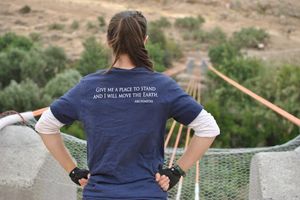
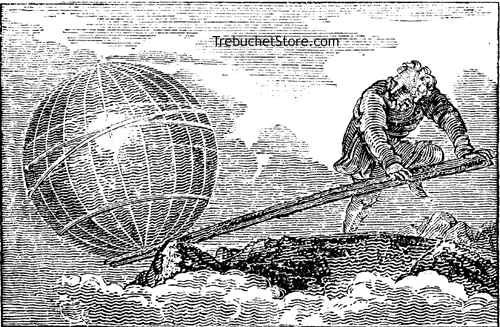
“Give me a place to stand and I will move the Earth.”
These are the words of Archimedes, a famous mathematician, engineer, and inventor who lived in 3rd century BC. He was referring, of course, to the “Law of the Lever” and that, with a long enough lever and with enough strength, even the heaviest objects could be moved — the Earth included.
Since Archimedes first put these words down, they’ve been repeated often, in the speeches of politicians, scientists, great literary minds, you name it. They’ve been used in the context of revolutions, presented to graduating classes of students, politicians’ speeches, etc.
There’s a good reason these words have been used so frequently. It’s because they’re true! We’ve always had the tools (the “levers”) to move the Earth and make a difference.
At no point in time has this been more true than present day, in which the world population numbers 7 billion individuals, the fastest computers have peak speeds of 20 petaflops per second, and the processing power in the average cellphone today is greater than the Apollo computers involved in the first moon landing. The point is, there is such great potential in so many areas and a large number of resources and opportunities available!
At a time when such incredible technological innovations and scientific advances are available, when there is so much valuable human capital to make a genuine and positive impact, and when resources are available, it seems preposterous that so many of the other 7 billion individuals live without the basic amenities to ensure their very survival. This feeling only increases when the disparity of living conditions, access to amenities, etc., is taken into context.
This is one of the topics we’ve recently covered during our “Common Ground” sessions. As students, we have great opportunities and resources. Many of our group members agreed with the idea that it’s our responsibility, our duty, our obligation to pass on some of the tools (the “levers”) that we’ve been given access to and knowledge of to others.
Change cannot occur through one individual, however. We doubt that Archimedes, as brilliant as he was, would ever be able to move the Earth using a lever. However, his contribution of this idea was just as important, because it put into motion the idea that such a widespread collaborative effort (a longer lever and greater strength, if you will) would be necessary to truly make a difference. Together, we can become the lever that sets this motion in change in the Naluja Community.
We can move the Earth! Figuratively, of course. It would never do for the Earth to shift from its orbit.
Our most recent meetings have introduced a new element called "Common Ground"! We've introduced them as a way to get perspective on the work we've been doing as a student group and to draw inspiration from other people in the world of global development who've successfully been able to make a change.
As students, it's easy for us to get bogged down in the everyday tasks and develop tunnel vision. There's always another problem set or essay due, email that needs to be taken care of, material to study, sleep to catch up on. But it's important to us that we don't develop tunnel vision and ignore the larger reason of why we're involved in such an extraordinary group as Engineers Without Borders. Common Ground has been a way for us to set aside a couple of minutes every other week and reflect on what we're doing, have done, and are looking forward to achieving. Last year, it was to break ground on our Naluja Program by sending travelers to Zambia. This year, it's been to work on developing antenna prototypes, and start research into water quality, sanitation, and power generation. It's a lot to take on, but we've been diligently working on making progress in time for next year.
Below is one of the recent videos we've watched, entitled "Build a Tower, Build a Team" and featuring Tom Wujec, who is a Fellow at Autodesk and has worked on business visualization, which utilizes design and technology to help groupwork become more efficient by understanding ideas and problem solving. The premise of his experiment is simple -- to have groups of people (businessmen, engineers, lawyers, and even kindergartners!) build the highest tower using dry spaghetti, one yard of tape, and one marshmellow. Who built the highest structure? Well, the results might surprise you.
This video has showed us how important collaboration is among engineers. No one person can attain success all on his/her own, especially on something as important as our program and projects in Naluja. We hope to continue our collaborative efforts well into the future!
Looking to get involved in EWB-BU and make a change in the Boston Community? Come volunteer at Community Servings this Friday from 1-4 pm!
Community Servings is a non-profit organization in Boston that provides food and nutrition for individuals and families dealing with chronic illnesses and disease. All meals are homemade and are free, and "send the message to those in greatest need that someone cares." Volunteer tasks include preparing and packaging meals, delivering meals to clients, assisting with events, etc.
It's a great way to spend a Friday afternoon and you'll be helping many people in need in your own Boston Community. At EWB-BU, we focus a lot on helping communities help themselves (such as in Naluja), and we'd like to help out in our own community as well. We think Community Servings offers a great service to those in the Boston Community, and are excited to help out.
Contact us at ewbexec@bu.edu if you'd like to help us make a difference!
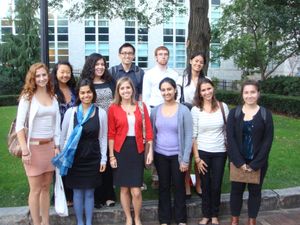
It's been a while since we've spoken to you last but full of activity. Since our last blog post, we've had two meetings (with great turnout!) and taken 14 of the EWB-BU group to the 2012 Millennium Campus Conference (MCC) at Northeastern! It's been great having such a large interest in our work and great attendance at our meetings. We appreciate that all you newcomers are taking the time out of your Sundays to spend time with the rest of the group and work towards a common goal. MCC 2012 (9/14-9/15) was a blast! We were able to take 14 of our members to attend the conference, which was chock-full of incredible people in the world of global development, such as:
Paul Farmer (Doctor, Founder of Partners in Health (PIH))
Leymah Gbowee (Liberian Peace Activist, 2011 Nobel Peace Prize Winner)
Jeffrey Sachs (Director & Professor of Earth Institute at Columbia University, Economist)
Emilia Pires (Minister of Finance, Timor Leste)
Steve Radelet (Chief Economist, US AID)
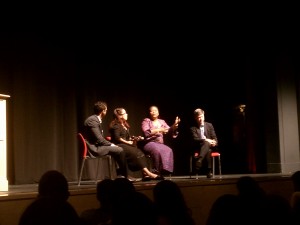
... and many others! It was an eye-opening event, to be sure. There were approximately 1,200 students, among many other people, who attended the event from different groups, different states, and even different countries. In addition to hearing such illustrious personalities and world leaders speak (see above), we were able to listen to and participate in panel discussions and workshops, discussing issues such as "The Roadblocks to Providing Care" and "Building Sustainable Projects on the Ground" to more practical strategies such as "Cross-Sector Collaboration" and "Community Partnerships." We hope to share all these ideas with you, so keep posted. Attending the conference really made us realize that there are so many different aspects to consider and be cognizant of when working in global development. It's definitely a very lofty goal, and we are more determined than ever to help the community of Naluja. Since not everyone was able to go, we'll just leave you with some of the more memorable quotes from our time there:
"We are moving from the era of economic development to the era of sustainable development." - Jeffrey Sachs
"Some say that we're wasting our time on people in poverty. I'm here to say that they are wrong." - Steve Radelet
"You can't plan ahead for defeats, but you can build partnerships to help." - Dr. Paul Farmer
"If you want to walk quickly, walk alone. If you want to walk far, walk together." - Maya Cohen
"[Poverty] can be ended... we have to choose to end it." - Jeffrey Sachs
"It's not the level of qualification you bring, but the passion and commitment you have to the people you work with." - Leymah Gbowee
"Above all, people want opportunity." - Emilia Pires
Thank you to those who have supported us in the past. If this conference has taught us anything, it's that we have a long way to go.
If you are interested in what we do, contact us at ewbexec@bu.edu. We're always looking for more people to join us on this journey!
Our travel team is back safely from Zambia and we'll be hearing from them shortly for a more in-depth account of their time in Zambia. They had a pretty exciting time on their pre-assessment trip. They were able to visit the city of Lusaka, the districts of Choma and Kalomo, and the community of Naluja. They were also able to meet a lot of people during their travels including our NGO partners, the community members of Naluja, American doctors running their own successful hospital, and even a Zambian Parliament member! They've been very busy and the last two weeks have been exciting for our travel team, to say the least.
Our team did a lot of hard work in not only laying out the groundwork for a strong relationship with the Nalujan people, but also through the data collection they did for assessment of the needs of the community. The team was able to gather information on water, sanitation, solar energy, road maps, and cell phone signal. Additionally, the team was able to meet up with another community in the Kalomo area that has already been able to implement some solutions to the infrastructure problems Naluja faces. The travel team was able to do some data collection on how well the other community was able to implement these solutions and any problems they faced along the way; the hope is to use this community as a model, of sorts, for Naluja.
On a lighter note, the team were able to enjoy some other things in Zambia. They were able to try a Zambian food called nshima (made of cornmeal) and explore the Nalujan community and spend time with its occupants. During their stay in Naluja, our travel team all got Zambian names and some even got marriage proposals! Our team was also able to visit Victoria Falls and two of the team went bungee jumping over the falls - it was definitely an exciting and memorable experience for them.
We'll have more information for you as soon as we are updated more thoroughly by our travelers. Until then, let's look to the future.
We're been working towards this pre-assessment trip for a long time, and now that it's done, we should definitely take the time to celebrate! However, we must also remember that we've now got a lot of valuable information about the Naluja community and we must put it to good use. All the information the travel team was able to get about Naluja can be used to determine which projects would be the best to implement in Naluja and help in improving the quality of life for the members there. We must look to take the next, necessary steps toward implementation.
Much of this will be taking place over the next year! We have a lot of work to get done now that the information has been obtained, and we welcome every one of our existing and new members at EWB-BU to help us with our program in Naluja. We have a lot of exciting events to help us along the way, including our annual Silent Auction, the upcoming Millenium Campus Conference, the EWB Regional Conference, and our Spring Film Festival with the EWB Boston Professional Chapter, to name a few.
We're really excited about having completed this first step with a pre-assessment trip. It'll enable us to go on implementation trips in the future and truly become a part of the change in the Naluja community. Join EWB-BU and become a part of the change!
EWB-BU members Grace Wang, Declan Bowman, and Nathanael Lee, in addition to mentor Mohammed Jafri of the Boston Professional Chapter, left for our pre-assessment trip on August 13. They plan to come back on the 27th.
During the two weeks our team is in Zambia, there is a lot to get done! This is a pre-assessment trip, so our team will be looking to get a better understanding of Naluja, the community where our program has opened, and of its people. By sending our members to Zambia, we hope to pinpoint some of the problems the Naluja community is experiencing and start brainstorming projects that might be able to appease these needs.
One of the ways we'll be collecting data is through a Baseline Health Assessment, with which we'll try to explore the health-related challenges the community faces. Our team will be collecting information about the Naluja community through interviews with the residents and their own observations. We'll also be using data already compiled by Measure DHS and the Central Statistical Office of Zambia. If you'd like to take a look, check out the following links:
By the end, we hope to get a better sense about the needs of the community so we can figure out to best address them.
Check back on our blog soon for more updates about what we're doing in Naluja, Zambia!
We're really excited to be able to send members of EWB-BU to Zambia! The entire group has been working towards this goal for a very long time, so it's very exciting to see all the hard work come to fruition. Thank you to our members for helping us reach this point! We wish our travel team the best of luck in Zambia!
As of Wednesday, June 6th, EWB has had its 10th birthday! Ten years of commitment to the application of engineering principles to raise the living standards of the world's poorest.
Today is a great day to remember how far this group has come. The dedication of all of the EWB members has resulted in the betterment of 2.3 millions lives in 48 countries! Many lives have been improved as a result of EWB's dedication. It's great to say that the existence of this group and the commitment of these members has actually made a visible impact.
Today should also be a day to look at the present and the future, and to answer the questions that arise. What are we working on right now? How can these projects and implementations be made better? In what other ways can we help to make a difference? What are our plans from the future? Where do we go from here? Being complacent is not an option. Already, this group has come so far. This needs to continue so that we can continue to make an impact.
We hope everyone's vacations are going well and everyone has been able to relax on this much needed break!
Looking to the future, the 2012 Millennium Campus Conference (MCC) is coming up in September. It will be held at Northeastern University on Septermber 14-15, 2012. The MCC is held as part of a greater effort by students across many universities to end extreme poverty as well as to achieve the United Nations Millennium Development Goals (MDGs) set forth in 2000.
Every conference has a keynote speaker. Speakers of past years have included: K'naan (poet, singer); John Legend (singer, Show Me Campaign); Dr. Paul Farmer (Partners in Health); and Adam Braun (Pencils of Promise), among many other notables. This year's speaker has been announced as Dr. Jeffrey Sachs.
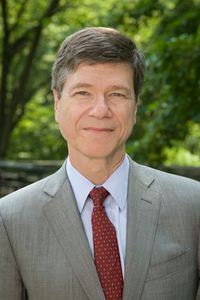
Dr. Sachs has been involved with MCC for many years on the Board of Advisors. Additionally, he is the director of The Earth Institute at Columbia University and a Special Advisor to the UN Secretary-General Ban Ki Moon. In addition to these impressive accomplishments, Dr. Sachs has been heavily involved with the fight against extreme poverty, having served as advisor to many governments with regard to economic strategy and healthcare in developing countries, and is considered the world's leading expert on economic development. Having worked with such people and organizations as Pope John Paul II, the African Union, the World Health Organization, Polish Financial Minister Leszek Balcerowicz, Soviet President Mikhail Gorbachev, and Russian President Boris Yeltsin, Dr. Sachs has become a very important and influential person. Indeed, he was recognized as such, being listed twice in Time Magazine's 100 Most Influential World Leaders.
With such an impressive resume and inexhaustible drive to help ameliorate conditions in today's developing countries, Dr. Sachs is indeed a very welcome guest at this year's Millennium Campus Conference! It will be an interesting and enlightening experience to listen to him speak, based on his extraordinary knowledge and previous direct experiences in the developing world, and hear his views on the world and how each of us can contribute. Needless to say, we're really looking forward to MCC 2012!
The video below details Dr. Sachs' ideas regarding technology and connectivity and how the two can help to springboard the developing world forward. With the advent of cheaper technology, the entire world becomes accessible with just the click of a button, and within the comfort of people's homes. Even in some of the most rural areas, its inhabitants are able to connect to the outside world through the use of a simple mobile telephone. Mobile telecom is extraordinarily cheap in developing countries, and has helped many nations to advance in that respect. This idea of communication with the outside world and the flow of information has enormous consequences.
Enter EWB BU. This is one of the things we've been working toward with our antenna project to extradite the results of Dried Blood Spot (DBS) tests for HIV using mobile phones and Short Message Service (SMS). We've definitely taken Dr. Sachs' example as inspiration and hope that our trip to Zambia this summer will help us forward in our project and one step closer to implementation!
Here's what you need to know about the Live Below the Line Challenge:
You have 5 days - March 7th to March 11th.
You have $1.50 per day to feed yourself.
Ready? Go.
Join the EWB-BU team this year as we try to Live Below the Line! 1.4 billion of the world's population lives on less that $1.25 per day, in extreme poverty. Many people are suffering as a result and should not be allowed to continue. That's where Live Below the Line comes in.
Live Below the Line is a fundraising campaign to raise awareness of the difficulties people face when living in extreme poverty, when sustenance is hard to come by. This is done by challenging people in developed countries to live under the same conditions (eating less than $1.25 worth of food per day).
"To really tackle extreme poverty, we've got to try to understand it - and what better way than by spending just a few days living below the poverty line." We often hear that most of the world lives in unimaginably difficult conditions, but this information is not realized until it has been experienced. It's easy to sympathize, but it's harder to empathize. And only when that empathy has been realized can one truly just begin to grasp the severity of the problems that 1.4 billion of the world's population have to contend with.
If you're interested in joining, please do! There needs to be greater awareness and movement toward the eradication of extreme poverty around the world. Click on the second link to sign up for the EWB-BU team! For more information, click on any of the following links:
Today is World Water Day! It is important to take a moment today to recognize the great need in this world for water. In countries such as the US, access to clean drinking water is not a problem. However, it can be one of the main concerns for survival in less fortunate countries. Life without easy access to water is difficult one because of the many uses it has in our everyday lives. Bathing, cooking, cleaning - water is necessary for all of these things, among many others. Hygiene and good sustenance is difficult to obtain. We depend heavily on water directly and indirectly (e.g. its use in the manufacture of many of the products we use) for many things. For more information about how we depend on water, click on the following link: http://www.thegatesnotes.com/Topics/Development/Water-Water-Hardly-Everywhere.
Access to clean drinking water is not readily available in poorer countries due to a variety of reasons, especially in rural areas. In Zambia, for example, only about 60% of the population has access to an improved water supply (http://www.nwasco.org.zm/pdfs/sectorreport2010-11.pdf). The situation is complicated by seasonal changes. While a long-term solution is needed, obviously, as a solution to this problem, there have been many simple technologies that have been implemented in the meantime in an effort to get better access to clean water, such as:
There are many available methods to help get easier access to clean drinking water. Why, then, is it still a problem? Water is a necessity for survival; it is a very basic need. It's a shame that even though the means to obtain clean water are available, not everyone is able to gain access. Learn more about the problem and ways you can help at: http://www.unwater.org/worldwaterday/.
The BU Chapter of Engineers Without Borders is looking into the possible implementation a water filtration system in Zambia this year, and we're glad for World Water Day because it has certainly opened our eyes to the need for water in the world. Please let us know if you'd like to become involved in our project!

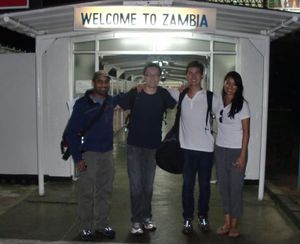

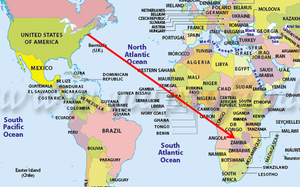 Our travel team has left for Zambia!
 We hope everyone's vacations are going well and everyone has been able to relax on this much needed break!
 Additionally, he is the director of The Earth Institute at Columbia University and a Special Advisor to the UN Secretary-General Ban Ki Moon. In addition to these impressive accomplishments, Dr. Sachs has been heavily involved with the fight against extreme poverty, having served as advisor to many governments with regard to economic strategy and healthcare in developing countries, and is considered the world's leading expert on economic development. Having worked with such people and organizations as Pope John Paul II, the African Union, the World Health Organization, Polish Financial Minister Leszek Balcerowicz, Soviet President Mikhail Gorbachev, and Russian President Boris Yeltsin, Dr. Sachs has become a very important and influential person. Indeed, he was recognized as such, being listed twice in Time Magazine's 100 Most Influential World Leaders.
 Here's what you need to know about the Live Below the Line Challenge:
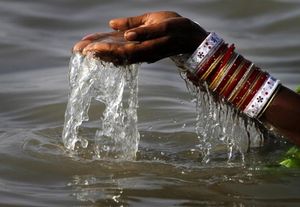 Today is World Water Day! It is important to take a moment today to recognize the great need in this world for water. In countries such as the US, access to clean drinking water is not a problem. However, it can be one of the main concerns for survival in less fortunate countries. Life without easy access to water is difficult one because of the many uses it has in our everyday lives. Bathing, cooking, cleaning - water is necessary for all of these things, among many others. Hygiene and good sustenance is difficult to obtain. We depend heavily on water directly and indirectly (e.g. its use in the manufacture of many of the products we use) for many things. For more information about how we depend on water, click on the following link: