By Marette Penington
Introduction
World War I left an economically, politically, physically, and emotionally divided and devastated Europe. England, France, the Soviet Union, Japan, Germany and other countries had faced countless causalities and were exhausted. The Treaty of Versailles in 1919 was created to resolve the destruction that Europe had been left with. Germany and its allies were given harsh, massive ramifications. From this, Europe tried to pick itself back up. During this period, ideologies, like Nazism, Fascism, and communism, became prevalent, Europe’s economy, beginning in the middle of the 1920’s, recovered, for the most part, and several issues, like Germany’s large reparation bills, were worked through. Despite all the events during this period, the origins of the Second World War are certain to most: the Treaty of Versailles. However, this has been highly debated over the last few decades. With this debate, numerous other interpretations of these origins have risen. For example, some focus on the ideology, economics, or even just Adolf Hitler. In retrospect, all of these aspects are factors in the outcome of the Second World War.
This research guide examines various sources on this topic. It includes sources in the form of books, articles, reports, and videos. The sources are separated into sections, general overview, social, economic, and ideological causes of the war. Because of this, the sources offer a wide range of opinions on the topic. The general overview sources provide arguments and views of the general origins of the war. On the other hand, the social, economic, and ideological sources are more specific and only argue the respective causes as the cause of World War II. With this in mind, none of the sources propose the Treaty of Versailles as the main or most significant cause of the war. This guide will portray the diverse focuses and interpretations of the origins of the war.
General overview
Bell, P.M.H.. The Origins of the Second World War in Europe. London: Longman Group, 1986.
- This book analyzes several interpretations of the origins of World War II. It is able to look at both sides of every argument before drawing its own conclusion. It points out the social, economic, ideological, and military influences on the start of the war. The book creates a solid background of the events in Europe between 1919 and 1939 that lead up to the war. Overall, P.M.H. Bell creates a thorough examination of the origins of the Second World War and gives the reader a chance to discover numerous different interpretations and come to their own opinions and conclusions. It is easy to understand and uses great organization of the author’s points and arguments.
Taylor, A.J.P. The Origins of the Second World War. Simon & Schuster, 1996.
- In this book, the author, A.J.P. Taylor, draws some highly controversy and interesting conclusions about the origins of World War II. One of his arguments is that Hitler never had any plans for German expansion or a great war. He also argues against several accepted truths about the causes of the war. Besides this, he discusses the influence of the Treaty of Versailles, economics, and Hitler’s foreign policy. This book makes convincing arguments and is a respectable source of information about the basis of the Second World War. It can be hard to follow on some points; however, the simple language makes it accessible for anyone.
North, David. “Seventy years since the outbreak of World War II: Causes, Consequences and Lessons.” World Socialist Web Site, 2009.
- This is a report based on a lecture that addresses the general causes, consequences, and lessons of World War II. With these topics, the report also includes different analyses, figures of the total deaths in the war, and an explanation of the significance. Although this gives a decent overview of the causes, it sometimes slips into biased statements and arguments. Still, this is a good source for the generality of the topic, while also including extra important facts on other aspects of the war.
Overy, R.J.. The Origins of the Second World War. Pearson, 2008.
- Unlike most books on the origins of the Second World War, this book examines this topic on a more multi-national level. The author argues that to correctly look at this topic, it has to cover the topic internationally, the decline and rise of different empires. The author also examines Germany’s invasion of Poland and Hitler’s reaction to the war that came from this action. This book gives a fresh, clear explanation of the causes of the war and examination of the causes from the perspectives of Japan to England.
Social
Kershaw, Ian. The ‘Hitler Myth’: Image and Reality in the Third Reich. Oxford University Press, 1987.
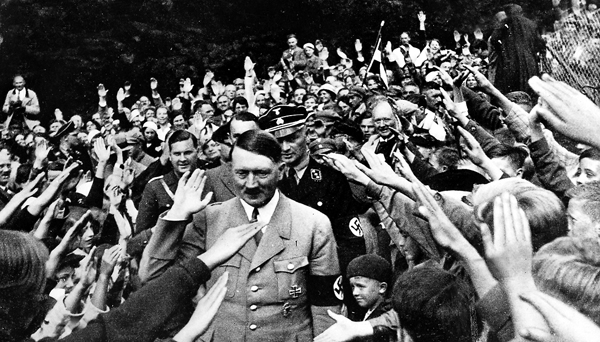
- This book provides a thought-provoking analysis of Hitler’s personality and his popularity with an enormous amount of people. The author explains the importance of Hitler’s image and the propaganda that accompanied it. He also provides useful data that portrays the different stages of this myth. Overall, the book focuses on primary sources; such as information from Nazi party officials to the opponents of the Nazi party. This source gives a fantastic explanation of the ‘Hitler Myth’ and how it worked the way it did. The data provided helps the book achieve its strong standing.
This video is the first part of the journey of Hitler’s rise to power. It focuses on the events that led to the dominantion of the Nazi Party and why they did. This source is a good source of background information on the people Hitler surrounded himself with, the reasons people were attracted to him and how his popularity rose.
Economic
Gordon, Robert J.. Did Economics Cause World War II?. National Bureau of Economic Research, 2008. http://www.nber.org/papers/w14560.pdf.
- This article examines the economic influences on the Second World War. It points out that there is little focus on economics has a cause of the war, and this mostly consists of discussion of economics and its influence on the outcome of the war. This article largely references the book, Economic History of Nazi Germany, by Adam Tooze. It also largely discusses Germany’s agricultural situation and the inevitability of Germany’s invasion of the Soviet Union. This source gives a rare view about economics as a major cause and expresses it through facts and strong points.

Ideology
Bendersky, Joseph W. A Concise History of Nazi Germany: 1919-1945. Lanham, Md.: Rowman & Littlefield Publishers, 2007.
- This book, while also looking at other factors, majorly focuses on the Nazi ideology and its influence. It discusses the decision making that resulted in the Nazi rules and practices. Bendersky gives an overview of general factors, social, economic, and political, that took part in the cause of the war. This source is useful and reputable when looking at the Nazi ideology, as well as an overall look at the origins of World War II. The book provides a great outline topic and appeals to several viewpoints.
This video focuses on how Nazism and Fascism were causes of World War II. It starts from explaining the instability of Europe after World War I and continues to the rise of Nazism and Fascism and their connection. This source provides a thorough description of events that led to the Second World War and the involvement of ideology. It includes numerous images and videos from that time to strengthen its argument.