What do you see, Professor? “I see myself holding a pair of thick, woolen socks.” Harry stared. “One can never have enough socks,” said Dumbledore. “Another Christmas has come and gone and I didn’t get a pair. People will insist on giving me books.”
Harry Potter and the Sorcerer’s Stone
“Why would you knit socks? Can’t you buy them?”
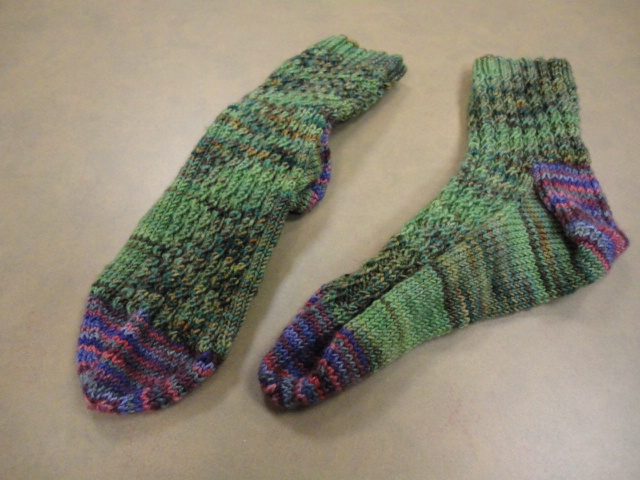
Short Socks
That is what your friends and family will say when you tell them you are going to knit socks. You tell them from me that store-bought socks are loveless, flimsy things, not to be trusted. You have not known true warmth until you have worn a hand-knitted sock. Hand-knitted socks are luxurious to wear, and when they come out right you feel like you have achieved something beyond the ordinary daily types of achievement. It’s beyond “take out the trash” but not quite “Shackleton gets to dry land.” The finished object aside, socks are a wonderful way to learn many knitting techniques. With just one sock you will learn:
- How to cast on and join for knitting in the round
- How to knit a rib stitch
- How slip stitches
- How to turn a heel (which is so fun)
- How to decrease stitches (both k2tog and ssk)
- How to pick up stitches
- How to shape a toe
Not bad for a humble sock. There is no other part of our body that it so complex to cover up and keep warm, from a knitting perspective. Does all of this seem daunting? It isn’t. If you take your time and go step by step, it is surprisingly easy.
For the Sock (Knitting) Hop, we will be using the Universal Sock Pattern, which the designer has been kind enough to make available for reproduction and distribution (see copyright permission at the bottom of the pattern.) It’s a bit loquacious for a knitting pattern, but it has lots of useful information.
There are several ways to knit socks. Two common ways are with two (2) short circular needles or with five (5) double-pointed needles (dpns). I will be using two circular needles because I find it easier. However, if you want to use dpns, go ahead. This pattern is written for dpns, but I will show you how to adapt it for two circular needles.

Detail of Laura's sock
For this project, you will need:
- 100 grams or 4 ounces of yarn of any weight
- Either two 16” circular needles in the size that is appropriate for the yarn, or one set of double pointed needles, (dpns) in the size that is appropriate for the yarn. Dpns are sold as a set of four or five needles. Get a set of five. Wooden needles are better when you are starting out because the yarn will not slip.
- Stitch markers, or scrap yarn to make stitch markers
- A measuring tape
- A tapestry or yarn needle
- A pencil
- A printed copy of the Universal Sock Pattern to mark up

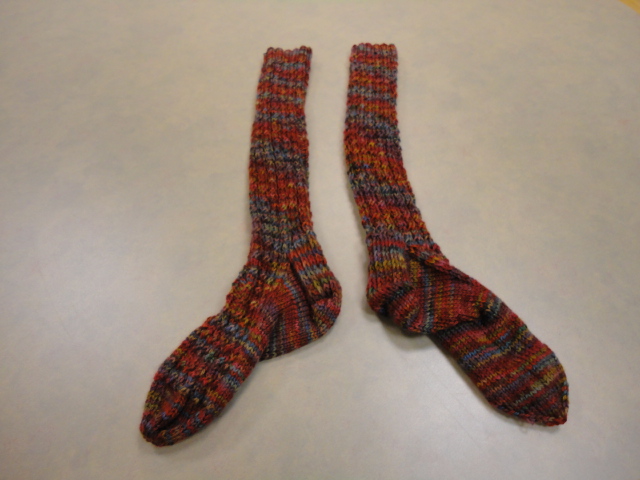
Long Socks
It is very important that you select needles that are the right size for the yarn you are going to use. If the needles are not the correct size, the socks will not fit. Check the pattern to see what size needles you need. N.b. The pattern calls for casting on with larger needles than the ones you will use to knit the sock. If you cast on loosely, you don’t need an extra set of needles.
Samantha Khosla
Sock Meister
