Blog

EU-Views: Iris Goldner Lang

(Re-posted from EU Futures)

26160980810_073837930b_k-e1471476803160Name: Iris Goldner Lang
Nationality: Croatian
Occupation(s): John Harvey Gregory Lecturer on World Organization at Harvard Law School (Winter 2016); Jean Monnet professor of European Union law and UNESCO Chair on Free Movement of People, Migration and Inter-Cultural Dialogue at the University of Zagreb, Faculty of Law; President of the Croatian Society for European Law (affiliate of FIDE)
Connection to Europe: European citizen; studies EU internal market law, free movement of persons in Europe, EU migration and asylum law, association agreements, EU institutional law, EU health law and policy; took part in accession negotiations between Croatia and the EU as a member of three working groups on workers, services and establishment and on institutions

Date of interview: May 10, 2016

This episode is a conversation with Iris Goldner Lang, a Jean Monnet professor of European Union law and UNESCO Chair on Free Movement of People, Migration, and Inter-Cultural Dialogue at the University of Zagreb, about the influence of the refugee crisis on European integration. Lang discusses the moral and legal obligations of the EU to properly handle the migrants attempting to enter Europe, and explains how European institutions can rely on mechanisms beyond the political sphere to solve the crisis. She describes the current trend of regressive integration, which has resulted in the closing of Europe and the restriction of rights and freedoms of both migrants and EU citizens.

The interview was conducted by Olya Yordanyan, EU Futures Project Coordinator. A transcript follows.

IGL: My name is Irish Goldner Lang. I’m a Professor of European Union Law at the University of Zagreb in Croatia, and I’m spending the academic year 2015-2016 in Cambridge, at Harvard Law School. I’m here as a Visiting Professor, and I’ve been teaching—together with another colleague from Zagreb—a course called Global Effects of European Union Law, which was taught in winter term at Harvard Law School. I’m also a Fulbright Fellow, so I’m doing research this year, and in summer 2016, I’ll be back in Zagreb at my regular job.

OY: What future is currently emerging in the European Union?

IGL: Well, I don’t know, it’s very difficult to predict considering all that’s going on in terms of all the ups and downs that Europe has been going through in the past several years. There are currently a lot of issues, a lot of challenges, that Europe has to respond to. So it’s very difficult to see what will come out of it. I hope it will end up for the better but it’s very difficult now and politically there are a number of misunderstandings and disputes in terms of how to deal with the current problems. So we’ll have to watch and see. But primarily I think that Europe will have to find some kind of response to the mass refugee inflows that it has encountered in the past months and years and also it will have to find a way to speak in a more united way.

OY: So what kind of response would be best in your view in terms of addressing the immigration crisis.

IGL: In terms of addressing the refugee crisis, I would definitely opt for—and I think that’s the only right solution—is for Europe to respond in a humanitarian, morally acceptable way, by actually enabling anybody whose life is threatened to find their home in Europe. This is a responsibility; it’s not only a moral but a legal responsibility, based on human rights standards, based on the Geneva Convention, the refugee convention, and based on European Union law. As you know there have been different problems in terms of what is the right solution, but I think that despite the fact that everyone is saying the Europe cannot accept so many refugees, I think that if you look in relative terms, in global terms, the numbers are not that huge. We are talking about more than a million refugees that entered Europe and applied for asylum in 2015, and that is true. But if you compare that number with the total number of inhabitants in Europe, it represents only 0.2 percent of European population, and I think that Europe should be able to accommodate this number of people. Now is this the solution to the crisis? No, because we can expect more and more people around the world to run away from their homes for different reasons: because of wars, because of climate changes, and so on. I think that both Europe and other developed countries have to respond to these needs in a more global and united way. Either by establishing some kind of resettlement quotas or something like that. But it’s not only that. I think that Europe has to find a way to improve its decision making process not only with respect to the refugee crisis but in general.

OY: What do you mean specifically.

IGL: Generally speaking the way the European Union works is that decisions are made, mostly, by the Council of Ministers, which is an EU institution where representatives of EU member states sit, and also by the European Parliament. Usually the proposal of a new legislative act is done by the European Commission. Now it’s very difficult to somehow influence the way different member states would like the decision making process to develop. Sometimes different member states have different interests; bigger member states usually have a stronger say. There are different interests and different ad hoc groups that are created based on those interests. So it’s very politicized, I would say. And I think that the European Commission, which is a kind of executive institution, which is there to propose certain measures, should have a stronger say. Because that’s the institution that represents the interests of the European Union and further European integration. So I think that the European Commission primarily has a responsibility to act in a stronger way without so much being influenced by different member states.

OY: You talked a little bit about integration but I would like to learn about your vision of the future of European integration. How do you see the future of European integration?

IGL: OK. There has been a lot of talk about Europe, actually, of dis-integration of Europe, due to all the crises that Europe has gone through in the past decade or so. I don’t think that Europe actually—at least not in the short and mid-term period—will disintegrate. I don’t think that this is going to happen. I really think that Europe is continuing its integration process, despite all the problems it’s facing. Now this integration process though might go in different directions. So we might have on the one hand different EU measures being adopted which will create a more introverted, more closed, Europe. And this is something we are facing now. There is this term, Fortress Europe, Europe becoming closed, and building walls at its external borders. And this is happening now because of the refugee inflows. And it’s not something that we want to see. This is not how we perceive Europe. Europe is not about walls. But it’s also a kind of a way of integration, which is happening at the moment. Further integration measures might go in the way of promoting free movement or restricting free movement. And we might have such measures in the future, not only due to the refugee inflows but also due to other developments, such as for example, the deal that has been struck between the European Union and the United Kingdom, which will be implemented in case of a positive vote in the UK referendum, in case the United Kingdom stays in the EU. So all these developments might influence the way that the European Union will integrate in the future. There are developments also which support the statement that Europe is integrating in different areas like banking union, the financial policies, and so on. So all these developments just testify that Europe is continuing its integration process, but it’s a different type of integration process in comparison to the one we have witnessed in the past several decades.

OY: How would you characterize this different kind of integration?

IGL: I would say it’s an integration towards a more closed Europe. It’s not a progressive integration but a kind of regressive integration, which is sort of restricting rights and freedoms.

OY: I would like to learn about your understanding of the role of democracy in terms of its impact on the future that is emerging in Europe.

IGL: Well I think definitely and this also is connected to the decision making process. Having democratic societies in Europe in all EU member states is crucial for further European developments. Because it is very important what is happening at national levels in different member states, in states like Hungary or the UK or France or anywhere else. Now the rise of different populist right wing movements that we have been witnessing in the past several years in Europe, that’s not a good sign. That’s not good either for those particular members states or for Europe in general. And these are the trends which are not going in favor of either of EU integration or any type of development of democratic societies. What should we do about it? Well, I think each one of us has a responsibility, as just an ordinary citizen, to react, to be involved, to participate, to help in terms of promoting certain principles and values that the EU is based on. Either by helping who are in need, like asylum seekers, or anybody else. So I think that we need to work on that. I think that EU institutions also have a role and a responsibility to act, and to react, to certain developments in countries like Hungary, Poland, and so on. And they shouldn’t stay quiet. So we’ll see how it’s going to go.

OY: What kind of reaction are you expecting?

IGL: Apart from the political pressure that can be put on certain member states, in case if statements or legal developments that go contrary to EU principles and values, apart from those political reactions, there are also legal reactions that can take place. One legal mechanism which is quite useful and which has been used in practice for many years is the so-called infringement procedure. So in the case you have an EU member state that does not respect EU law—so it fails to fulfill its EU law obligations—the EU Commission can start proceedings against that member state, which can end up with the judgment of the Court of Justice in Luxembourg. Which can proclaim that that member state should pay a penalty payment or a lump sum. There is another mechanism, which has never been used so far, it’s based on Article 7 of the treaty on the European Union, which basically enables the EU institutions and other member states to limit, or block, membership rights of a particular member state which has done something against EU values and principles. This mechanism has never been used. It’s very questionable whether it will ever be used because it requires unanimity of all the member states in order to activate this mechanism in the Council of Ministers, which is quite unfortunate because it is very difficult to have all the other member states going against a particular member state that might be doing something contrary to EU values, like, for example, Poland or Hungary are doing or are potentially doing. So there are now thoughts in the European Commission and elsewhere that this mechanism should be changed in order to make it possible to use it in practice. Because currently it’s just not possible. So we’ll see. I think that these mechanisms should be employed. So if you see the political mechanisms are not working, legal mechanisms should be employed to do something, and to warn those states that Europe is not about closing borders and building walls and barbed fences and giving some very homophobic statements and so on which go contrary to human dignity and democracy, but Europe is something else.

OY: You talked about the rise of nationalism and right wing parties across the European Union. How do you think this will affect EU governance and possibilities of European politicians coming together about immigration issues, security, terrorism, and such.

IGL: Definitely the rise of such tendencies do influence EU-level policies and politics. It’s unavoidable. Even if we talk about political parties that are currently not in power in certain member states. But then of course those who are in power might be influenced by them. So it does play a huge role. I think that also civil society, NGOs, have an important role in building respect among people. I also think that, based on the previous experience (not too good experience) of how Europe has managed to integrate people who are coming to different countries, that Europe needs to work on that as well. If you look at how different member states have in the past decades managed or not managed to integrate newcomers onto their territories, they haven’t done a good job. Now there is this fear—with good reason, I would say—that one million or more asylum seekers that have reached the European territory in 2015 will be properly integrated, which is important both in terms of their wellbeing and the wellbeing of Europe. Because Europe has certain values and principles of democracy and human dignity and so on, and you want those principles to stay in tact. You don’t want whoever comes to change the society in such a way as to delete those principles.

OY: If you were to think about the Europe we have today, and the problems Europe is facing, and to think of Europe ten years later, what kind of Europe do you see?

IGL: I don’t know, because I like to be an optimist, which is quite difficult at this time. I have a feeling that the way Europe is currently developing is very different in comparison to what its development had been in the twentieth century and it’s not for better. So I would like to see Europe in ten years time going on its previous track of promoting peace and stability, and not only economic development of all its member states. Of course economic development and wellbeing is very important, but peace and stability is equally important. And after all this is primarily why Europe and European integration had started sixty years ago. So I hope Europe will go in that direction. I am quite confident that if European integration had not happened sixty years ago, Europe would have gone through many more wars than it has. The development of European integration has actually prevented wars, and I think that people, no matter how old they are, tend to forget this, and tend to underestimate this crucial role of the European Union.

OY: Can the European Union continue acting as a soft power as it has in past years given all the changes in the international community that have happened?

IGL: We’ll see. But the thing is that the European Union, due to the way it’s structured, very much relies and depends on its member states. It’s not like the United States, which has its own army, which has its own border controls and so on. The European Union does not have that. In order to become a different type of power, you would need that change, which is currently not taking place. Whether we are going to see that, maybe, who knows? There are proposals currently on the table that the European Union should have some kind of a pan-European border force, which is one of the reactions to the refugee inflows. Member states are reluctant to have that. They don’t like the idea of having somebody else control their external borders towards third countries. So even this proposal, which is currently on the table, I don’t expect will be accepted, at least in the short term, so who knows?

OY: Is there anything I didn’t ask you about but that you want to talk about?

IGL: No, I think that’s basically it, but I would just like to emphasize that I really do think that there is a responsibility, on each one of us, as an ordinary citizen, no matter whether you are specialized in European Union issues, or working in a completely different field, no matter how old you are, to contribute to positive developments in the European Union. I think we have an obligation to participate, and to contribute to civic engagement.

Event Highlights: Critical Perspectives on the Law, Economics, and Politics of the EU’s Agreements with African States

On Tuesday, May 17, Daniela Caruso convened a workshop on the law, economics, and politics of the EU's Agreements with African states. The aim of the workshop was to shed light on recent developments in the trade and/or cooperation agreements between the north and south of the Mediterranean basin. The main focus is on the law and political economy of EU agreements with African countries, beginning with partnerships enshrined in the European Neighborhood Policy and then proceeding with EU arrangements with sub-Saharan states.

The workshop began with book presentations by Sara Poli, Associate Professor and Jean Monnet Chair of European Union law at the University of Pisa, Italy, and Mark Langan, Lecturer in International Politics at the University of Leicester, UK. Poli discussed her edited volume, The European Neighborhood Policy - Values and Principles (Routledge 2016), a legal analysis of the values and principles that form the basis for the European Neighbourhood Policy. Langan discussed his recent book, The Moral Economy of EU Association with Africa (Routledge 2015), on the impact of Africa-Europe trade and development co-operation on citizens in developing countries.

Prof. Kevin Gallagher (BU) led the discussion, offering insights on the evolutions of trade and development strategies in the Global South, while Prof. Daniela Caruso shared perspectives on “Trade and History,” based on co-authored work with Joanna Geneve on Algeria-EU relations. A lively conversation followed the presentations.


Created with flickr slideshow.

Event Highlights: The EU Refugee Crisis and the Changing Paradigm of EU Law (Europe and Law Series)

On April 7, we welcomed Iris Golder Lang, 2016 John Harvey Gregory Lecturer on World Organization at Harvard Law School and Jean Monnet professor of European Union law and a UNESCO Chairholder at the University of Zagreb, Faculty of Law. Professor Golder Lang delivered the second lecture in our "Europe and Law Series," an initiative of the Jean Monnet Chair in European Law at Boston University, on the topic of "The EU Refugee Crisis and the Changing Paradigm of EU Law."

04.07.16a

Iris Golder Lang is the module leader of two Jean Monnet Modules “EU Migration Law and Policy” and “EU Internal Market Law” granted by the European Commission. She holds a UNESCO Chair on Free Movement of People, Migration and Inter-Cultural Dialogue at the University of Zagreb. She has held a number of visiting lectures (LSE, University of Stockholm, University of Vienna, University of Lisbon, Court of Justice of the EU, European Parliament, Vrije Universiteit Brussels, Office of the President of the Republic of Croatia, Alpbach Forum Summer School, etc.). She is the editor of three books and the author of a number of articles, chapters in books and a book entitled From Association to Accession: How Free is the Free Movement of Persons in the EU? She is Editor-in-Chief of the Croatian Yearbook of European Law and Policy (CYELP) and president of the Croatian Society for European Law (affiliate of FIDE – International Federation for European Law) and the Croatian representative in the Odysseus Network.

The event began with Caruso’s introduction of Lang, who then outlined her presentation by explaining how she planned to talk about the huge refugee influx in recent years and months to Europe and how it has impacted both current and future EU law, and how she expects the entire European paradigm to shift. Making three distinct points, Lang explained how the refugee crisis has caused a dismantling of multiple EU rules in migration and asylum laws, how the crisis has effected the founding principles and values of the EU, and how the pressures of incoming refugees have brought to the surface existing issues prompting both inadequate and incorrect responses from EU institutions and Member States.

Beginning with a broader perspective, Lang used many statistics to place the European refugee crisis into a more global context, addressing how through the definition established by the Geneva Convention, only 19.5million of the 59.9 million displaced persons internationally were considered refugees. She continued by explaining how 90% of these refugees fled to neighboring developing countries, and she criticized the EU for claiming incapability to integrate and protect the migrants, even though only 1 million of the 19.5 million attempted to enter the EU in 2015.

Lang then briefly summarized the Schengen Border code, explaining the European experiment to create a zone without internal border controls, stating “it was wonderful,” as it positively impacted EU citizens psychologically and economically, as Schengen improved European markets as a result of free movement of peoples and goods. However, Lang explained that the free zone only works if common rules and policies exist at the external borders given the question of visas, asylum applications, and general immigration trends, thus placing nations located at the periphery of the EU under greater stress in handling the influx of refugees in recent years. She described how the potential creation of a Common European External Border Force through a supranationalized institution would not only require massive changes in EU law, but would additionally threaten the sovereignty of European states as they would be required to give up power to the EU. Lang discussed how in the past two years, more than half the Schengen states reinstated some form of internal border security controls in the face of the refugee crisis, and that looking forward she cannot predict whether Schengen will survive the securitization of European borders, as she argued that, while the physical construction of walls and fences are generally unsuccessful at keeping migrants at bay, the psychological fear of the “other” within European communities is rapidly becoming the greatest threat to the European experiment.

Lang then broke down how the Dublin Regulation is the legal instrument which allocates responsibility for processing asylum claims through its “state of first entry” rule, and how this system unnecessarily burdens Member States located at the external borders of the EU, which does not support the concept of European solidarity as it is unfair to nations such as Greece and Italy. She also explained how Dublin relies on the assumption that equal and adequate human rights standards exist across the EU, and how there have already been two human rights cases taken to the highest European courts that have ruled on the failings of Member States in handling the incoming migrants, resulting in several nations (Germany, Austria) suspending transfers of asylum seekers to the states they initially entered (ex. Greece, Hungary). Lang also explained how at the external border of the EU, immigrants are supposed to be identified and registered, but how Member States failed to take fingerprints and successfully process many refugees, exposing a large failing of the Dublin Regulation. Lang then explained the difference between reallocation (person already in EU moved from one Member State to another, within EU borders) versus resettlement (refugee running away from a 3rd country resettles in the EU), and how in 2015 the Member States adopted two controversial decisions agreeing to the reallocation of 160,000 asylum seekers from Italy and Greece given that several states find these arrangements “contrary to EU law”. Lang noted that only 272 reallocations occurred as of January 2016, and that the EU deal with Turkey is based on the same principle of resettlement as a “safe 3rd country” but how the issue of non-refoulement and the 1 for 1 deal have caused many European to question the agreement, leading Lang stating “the Dublin first entry rule is simply not working, it hasn’t been working for a while, but now it’s simply nonexistent due to the EU Turkey Deal.”

Lang then addressed the dismantling of EU rules, and how the influx of refugees have brought into question basic human rights, values, equality, and non-discrimination principles expected in Europe, thus underpinning the very foundations of the EU. She continued by reading statements made by EU politicians in recent years to demonstrate the xenophobic sentiments being expressed, contradictory to EU laws, and the “Ping-Pong” game of finger pointing and blame shifting between Member States. Lang then criticized EU institutions for inadequately responding, as they independently established qualifications and directives to deal with asylum seekers, resulting in limited harmonization and Member States failing to respect their obligations. She added that the Commission is still not doing enough, and that the question of implementation under Directives versus Regulations does not matter given the drawn out process such changes would require within the EU legal framework. She then explained some of the options Member States have, including cooperation with 3rd countries to keep migrants from arriving to Europe, quotas for the Balkan states, joint return operations to Africa, and the potential strengthening of the EU border through the establishment of a pan European border patrolling force called the “European Border and Coast Guard” under the authority of FRONTEX.

Lang’s concluding statements on the subject were critical, as she highlighted the insufficiencies of European institutions and called out Member States for failing to share the responsibility by facing this crisis with the solidarity expected under the EU framework, adding that developments in the EU are affecting European law. “We will have a European Union, but a changed European Union… an EU, quite paradoxically, that will be more integrated.” Lang explained how there will be increased integration in the form supranationalization of EU institutions such as FRONTEX, but that the results will reflect “Fortress Europe” and a regression of the past 50 years of European progress. She briefly described the growing European police state, and how increasing internal border checks threaten the Schengen Zone, not only for refugees, but bring into question the rights and identity of EU citizens given the laws regarding surveillance, data protection, and personal privacy, stating “there’s going to be a ‘Big Brother’.”

The event ended with an open discussion and several questions posed to Lang, the first regarding a comparison of the unification seen in the US following the Civil War and the potential emphasis on external borders in Europe leading to reduced internal controls. Lang explained her expectation that the external borders will become increasingly fortified but that Schengen is “up in the air” given the varying issues both at the periphery and within the EU. She briefly mentioned the concept of “benefit tourism” and how EU law is becoming more restrictive. She then shifted toward the impending Brexit referendum, and how that decision will impact a potential amendment to the right of free movement. A question about the arrangements made between EU Member States and MENA countries was answered by Caruso, who went into a long analysis of the Turkey Deal, and how a surface agreement varies greatly from a long-term solution and how the real issue is the question of human rights standards. Lang added that the shift of the migration routes to the East will reshape the arrangements already established within the parameters set by both EU and international law. The two speakers then addressed the question of integration and social mobility for migrants following the asylum application process, as well as the differences between refugees and economic migrants. Lang commented, “it ends up being a matter of luck where you end up being born,” as every national struggles with rules and regulations regarding the varying types of migrants, and that the dream for self-improvement, while idyllic, is not sustainable thus not supported by European or international law. She continued her statements on the huge and diverse waves of migrants around the world by saying, “do we need more rules about it? Do we need to change the Geneva Convention the definition of who we consider a refugee? My answer is no for quite pragmatic reasons.” Lang then delved into several reasons why amending the Geneva Convention would not necessarily be a good idea, but how she believes a “practical and global response” is something the developed world owes the developing world, as many Western states are at fault for many of the issues seen across the globe today, concluding “we are all responsible.”

Listen to the lecture on Sound Cloud!

Event Highlights: Eastern European Democracies and the EU Rule of Law Framework (Europe and Law Series)

On March 17, 2016, under the auspices of the Jean Monnet Chair in European Law and in collaboration with the Center for the Study of Europe, we inaugurated our Europe + Law lecture series. Vlad Perju, Director of the Clough Center for the Study of Constitutional Democracy at Boston College and a tenured Associate Professor at Boston College Law School, delivered the first lecture in the series on the topic of Eastern European Democracies and the EU Rule of Law Framework. Perju's primary research and teaching interests include the law of the European Union, comparative constitutional law and theory, international and comparative law and jurisprudence.

03.17.16

The event began with Caruso’s introduction to the European Law Series, addressing the question of whether law can fix the challenges facing the European Union or whether it enabled such issues to develop. After each participant in the discussion introduced themselves, Caruso welcomed Perju, who stated his hope to challenge the way the audience thinks about the EU. Specifically, he explained that he planned to discuss the future of Poland given the recent developments in other Eastern European countries such as Romania and Hungary, as well as the question of potential EU influence on impending Polish transformations. Perju explained how there are many matters that EU institutions need to address, and that the varying dimensions and levels of policymaking in Europe determine the potential reaction and tools made available to resolve these issues. Additionally, Perju outlined what he referred to as the intellectual question facing Europe today, claiming, “European integration is the French Revolution of our time,” forcing citizens to comprehensively think about politics. He explained that everyone should have opinions on these social, economic, and political issues, and EU institutions should reflect these perspectives rather than exclusively those of politicians and intellects in looking toward the future of Europe.

Perju described how the pace of developments in Hungary in 2010 and Romania in the summer of 2012 demonstrated how European institutions were taken by surprise, and how they are currently facing similar fast paced changes in Poland, stating “almost as if time has run out of patience… there is an accelerated rhythm in Eastern European politics.” He continued by explaining how, even in 2007, discussions about the future of Poland recognized that the nation was at a crossroads, either heading in its own direction or continuing the pattern of Eastern European development seen in in other former Soviet states, as there are “similar dangers in post-Communist Europe.” Perju summarized a conversation between two intellectuals analyzing this question, highlighting their recommendation to watch the developments in Russia under Vladimir Putin in recent years, ominously concluding, “there are times when the wind favors what’s mean in us rather than what’s noble.”

Perju explained how the majority of his presentation would focus on Poland, given its contemporary developments, but that he would also analyze Hungary and Romania given the constant changes and profound transformations attempted in each of these states. He further explained how Romania acts as a case study for where EU influence was arguably significant in preventing certain events to unfold. Perju stated that he expects Poland to develop independently from Romania and Hungary depending on where things are for EU institutions. He continued by explaining that profound transformations driven by politicians have been a staple of life in Eastern Europe following the collapse of communism, returning the region to the political organization seen prior to WWI. He explained that a peculiar feature in many Eastern European nations is the “political evanescence”, which results in political parties vanishing after electoral cycles, but he added that in Poland and Hungary resilient anti-communist sentiments have led to more political structuring.

Perju described how citizens in Eastern Europe have been good at throwing out incumbents in regularly scheduled elections, limiting many political parties and leaders from returning to power. However, as Perju explained, from 2002-2010 in Poland, Hungary, and Romania, there were political parties returning to power leading to 8 years of continuity. Similar to problems seen in Western Europe, where many political parties remain in power for longer consecutive periods, these Eastern European states face the issues of building tensions within and between political parties, growing corruption, and severance of connections to their electorates.

Perju explained the challenge for EU institutions by stating, “the EU does not have rules about some unitary form of domestic constitutional regimes – so each country has its own way of arranging its political affairs.” He continued by describing how the varying forms of government have different disadvantages and advantages. Using the example of the Parliamentary system, Perju explained how the structure of a parliamentary government promotes citizen involvement given the limited checks and balances, leading to a quite responsive regime that gains political traction. Perju also explained the disadvantages of Parliamentary systems given the danger of political fragmentation resulting from the necessary formation of coalition governments. He continued by using the example of Hungary in 2010, when the political party returning to power obtained a 68% majority government and had the power to amend the constitution 12 times, pass 800 new laws, and eventually make a new constitution. Perju highlighted the question of pace, addressing how EU institutions were shocked by the rapid changes in the framework of the Hungarian law system.

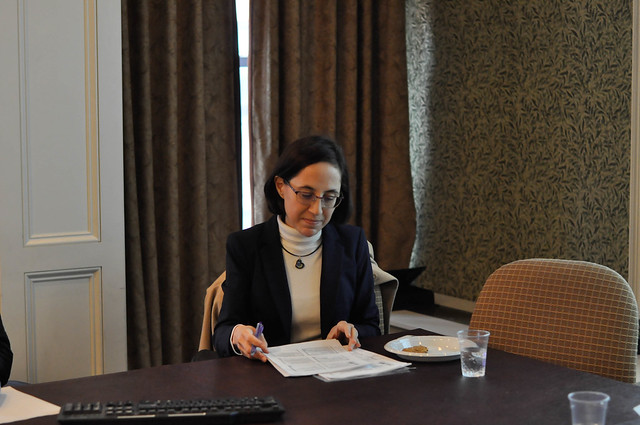
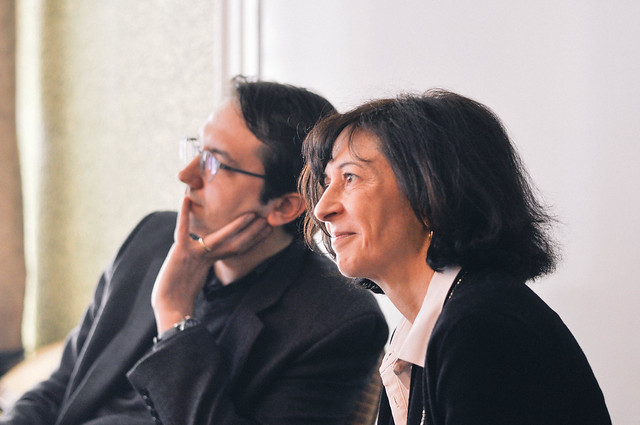
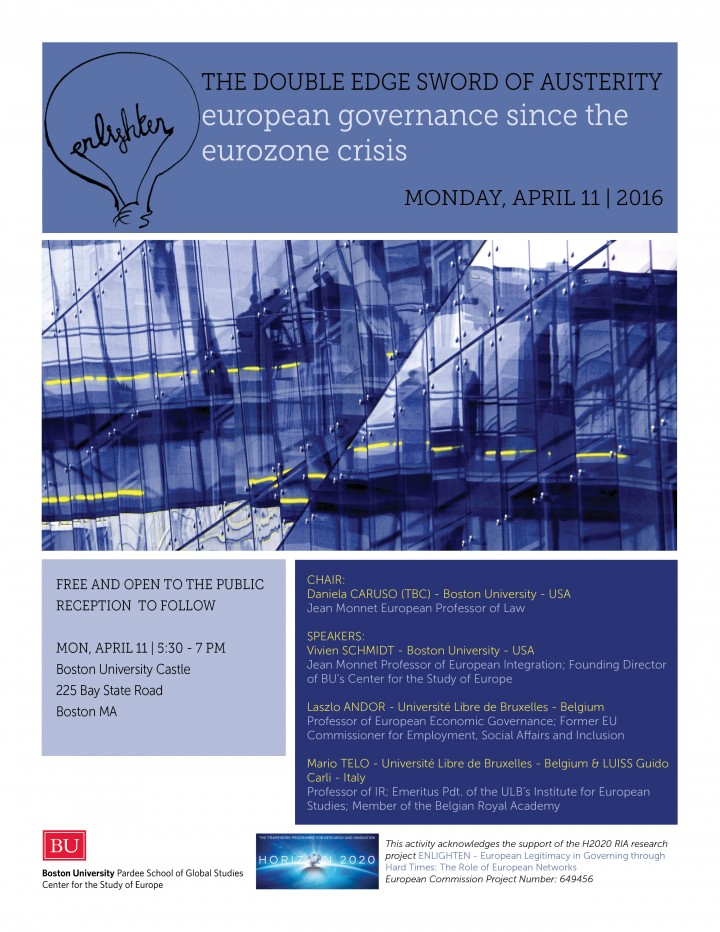
Event Highlights: The Double Edge Sword of Austerity – European Governance Since the Eurozone Crisis

On Monday, April 11th, we hosted a panel discussion on the topic of European governance during the Eurozone Crisis. The speakers included: Vivien SCHMIDT, Jean Monnet Professor of European Integration and Founding Director of BU’s Center for the Study of Europe; Laszlo ANDOR, Professor of European Economic Governance at the Institute for European Studies of the ULB and Former EU Commissioner for Employment, Social Affairs and Inclusion; Mario TELO, Professor of International Relations at the Université Libre de Bruxelles - ULB and at the LUISS Guido Carli di Roma, Emeritus President of the Institute for European Studies of the ULB and Member of the Belgian Royal Academy. The panel was moderated by Daniela Caruso, Jean Monnet Professor of European Law and Boston University Professor of Law.

The event began with an introduction of the panelists by Professor Caruso. Vivien Schmidt then gave her presentation, beginning with a theorization of the roles and of democratic legitimacy in the Eurozone Crisis, particularly in the context of Horizon 2020. She discussed how the Eurozone Crisis was not just the problem of economic of political issues, but instead the broader issue of legitimacy, explaining how “institution actors responded by governing by the rules, and ruling by the numbers.” Rather than responding to the crisis with deep integration policies such as mutualization of debt and Eurobonds, Schmidt explained how EU actors instead doubled down on the rules. She talked about how EU institutional actors began to reinterpret the rules with incremental changes, raising the question “how have EU institutional actors managed to bend or even break legally binding rules while retaining legitimacy through the Eurozone Crisis?” She broke down the necessary levels of building, coordinating, and communications regard the reinterpretations of legitimacy, and explained the different intensities in the crisis: the “fast burning” times of doubling down of rules and interest based decision making versus “slow burning” crisis when there is an ability to dig out and formulate new solutions.

Schmidt then turned toward the question of output and inputs within European studies literature regarding the effectiveness of EU institutional actor policies. She explained that output is the technological non-major actors with technical know-how and economic principles to reinforce legitimacy versus major political actors focusing on the ideas, interest, and values of the elites and the perception and normative principles of the citizens. Input was described as politics, in terms of citizen participation and governmental responses to the demands of the general public. Schmidt explained how input could be distinguished at the national and EU levels, as national input is focused on the government working for the people (leader to participation) while the EU level, various institutional actors link different sources of legitimacy. Schmidt then described the tradeoff between input and output, defining the “black box of governance” as the accountability, transparency, inclusion, accessibility, and ethicacy that institutional actors claim. Schmidt said “I call all of this ‘throughput’. Unfortunately throughput doesn’t work,” adding, “governing by the rules, ruling by the numbers did not work. Throughput did not necessarily provide good output,” and she identified unemployment, deflation, and low growth as the resulting failures of the Eurozone Crisis in this failed tradeoff assumption.

Schmidt then claimed that this situation is what caused the “reinterpretation of rules by self”, as the EU institutional actors only later realized that they had inadvertently trapped themselves in the rules they originally created, so they then go back looking for flexibility under the premise of “they say one thing, do another”. She gave the example of how the European Central Bank was completely redone but claimed its actions were “within its mandate” with the goal that “credibility [would lead] to stability” and continually claiming “we are following the rules” while the mandate was radically reinterpreted. She compared the actions of the European Central Bank to the European Commission, who continually denied changes and derogations to the rules, asking “whether the European Central Bank is the hero or ogre of the crisis?” and whether the Commission members are “the Ayatollahs or austerity?” or “ministers of moderation?”. Schmidt concluded by describing how democratization faces problems of legitimacy, focused on input, muddling through, and resulting in insufficient output.

The next panelist to speak was Laszlo Andor, who spoke about American economists in the late 1990s, who critiqued the Maasricht Treaty and the concept of the Eurozone. Andor described how some Americans predicted a future economic crash and even began theorizing a potential solution to save European economies similar to the Marshall Plan of the late 1940s. He then addressed the Eurozone Crisis, citing the importance of American aid - both direct and indirect - which has been channeled to Europe through institutions such as the IMF in recent years. Andor discussed how the concept of austerity was the center of conversations relating to the Eurozone Crisis, but how the tones of these discussions were dominated by critiques and questions surrounding the definition of austerity. Andor explained how austerity has multiple definitions and is overall both a outcome (of fiscal, monetary, and other policies) and an input (to the extent that in 2011-12 political parties were advocating responsibility and prioritizing stability through deficit limitations) within the institutional structure.

Continuing, Andor defined austerity as the situation when “governments are cutting expenditures, especially wages, but have sacrifices of real economics.” He claimed that, in times of adversity or economic downturn, institutions implement fiscal consolidation instead of economic expansionary policy. He critiqued this definition for being too narrow, as it exempts monetary policy. Andor explained that the problem facing Europe is not whether or not it can recover from the 'philosophy of austerity, but instead faces the problem that the overall architecture of the Maastricht Treaty is better for consolidation rather than growth. He then delved into the question of whether Maastricht needs to be modified or whether the Maasrticht Treaty needs to work through its intellectual failings, claiming that austerity can work in a small open economy but, when applied across multiple unique economies simultaneously, austerity can be counteractive and drain economies. Andor concluded by stating, “the EU is just too polarized, just too vulnerable and, as a result, [is] potentially facing the next economic downturn without the monetary system being repaired or prepared for it.”

The final panelist to speak, Mario Telo, began by identifying the three major challenges facing the U.S. and EU. The first named was the post-Cold War multipolar power structure and the resulting complex global governance which faces new threats that negatively interplay and tremendously affect the Eurozone Crisis. The second problem of enduring global economic uncertainties, after almost a decade of crisis, has been demonstrated by the unsatisfactory growth in the U.S. and EU when compared to the growth rates of the BRICS nations. Finally, Telo identified the challenge of deepening social consequences and the resulting domestic troubles facing Western liberal democracy, specifically citing the rise of populism, “what I call ‘authoritarian temptation’ on both sides of the Atlantic.”

Telo explained how the U.S. has more resources to cope with such issues as a Federal State, versus the EU which is a collection of states. He continued by citing differences between the U.S. and EU in terms of available budgets, ability to attract international investors, and the varying political challenges. For example, Telo described how the U.S. democracy is facing extreme polarization but can cope with these issues by channeling populist sentiments between the state and national levels, while the EU faces multiple independent anti-democratic movements in several Member States. He continued by explaining how Europe, while living through 6 years of economic downturn, has faced multiple other other crises simultaneously: the question of policy (e.g. Brexit, secessionist movements), the refugee emergency, and instability on the Eastern and Southern border given the rise of Islamic terrorism.

Telo discussed his worries regarding the fragility of the Eurozone, specifically its ability to cope with new global clash due to growing international debt, calling for a renewed intensity and prudence in the evaluation of EU policy. He then described the importance of German leadership in leading quantitative easing, adding that there is now a divide in whether a shift back from ultra-liberal economic policy toward the more traditional Keynesian policy is necessary. Telo stated that the parallels being drawn between todays crisis and that of the 30s are “not appropriated,” continuing by explaining how Keynesian economics aided in the under consumption, overproduction problems of the interwar period, but how currently the Eurozone needs new innovative policies. He described that the unequal distribution of debt has brought into question the mix of European policy and public goods, in addition to the role of Germany.

Addressing the emerging future of the EU, Telo identified two major questions Europe must face: what economic policy going forward and how do we democratize the Eurozone? He explained the recent steps backs “after the three democratization waves” and how populist leaders have made their admiration of Vladimir Putin evident in their critiques of the European democratic structure. Telo warned that “manipulation of fears can go very far,” bringing attention to the question of future European democracy in the face of national, protectionist, and authoritarian right wing movements across Europe. He then called for a new proposal for democratization of the Eurozone and new reforms for economic governance focused on national budgetary policy and centralization by the European Parliament to improve both democratization and participating in decision making. He describes the option of creating an annual assembly of national parliaments when the Member States would come together to address major issues focusing on coordination and cooperation, in addition to the establishment of a distinct Eurozone budget and the formation of a European Parliament committee dedicated to the Eurozone, based on his ideal of an EU centered upon a “concentric circle” of institutional architecture.

Prof. Caruso, who moderated the session, opened up for questions from the audience, including further explanation of the European Central Banks violations of its mandate and its potential contribution to the rise of populist movements, the question of who decides the extremity of flexibility and reinterpretations of rules, and the shifting dialogue of the European Commission from “stability is a prerequisite for jobs and growth” toward an emphasis on “jobs and growth are a prerequisite for stability”? While each panelist was given the time to address the questions posed by the audience, Vivien Schmidt asked, “what if we change our idea of EU and Eurozone governance to be less hierarchical, and instead more coordinated, more decent?” continuing by describing the possible model of the European Central Bank setting targets and Member States being given independent goals in the search for a solution to the Eurozone Crisis. Telo ended the discussion with a call to action for Europeans to address the challenges originally faced by Montesquieu, concluding: “without representation of the people and international power, the European project is condemned.”

This activity acknowledges the support of the H2020 RIA research project ENLIGHTEN - European Legitimacy in Governing through Hard Times: the role of European Networks European Commission Project Number: 649456