On April 7, we welcomed Iris Golder Lang, 2016 John Harvey Gregory Lecturer on World Organization at Harvard Law School and Jean Monnet professor of European Union law and a UNESCO Chairholder at the University of Zagreb, Faculty of Law. Professor Golder Lang delivered the second lecture in our "Europe and Law Series," an initiative of the Jean Monnet Chair in European Law at Boston University, on the topic of "The EU Refugee Crisis and the Changing Paradigm of EU Law."
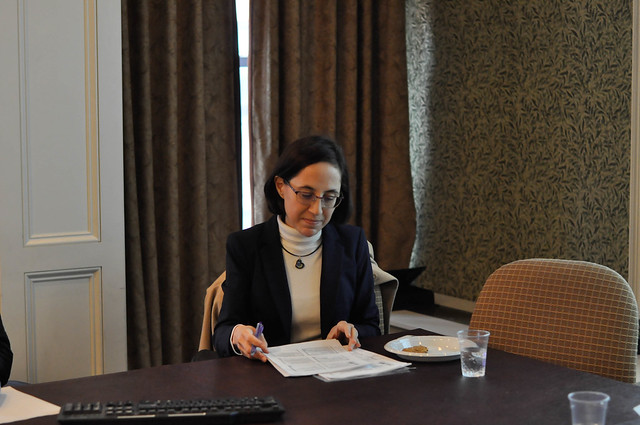
Iris Golder Lang is the module leader of two Jean Monnet Modules “EU Migration Law and Policy” and “EU Internal Market Law” granted by the European Commission. She holds a UNESCO Chair on Free Movement of People, Migration and Inter-Cultural Dialogue at the University of Zagreb. She has held a number of visiting lectures (LSE, University of Stockholm, University of Vienna, University of Lisbon, Court of Justice of the EU, European Parliament, Vrije Universiteit Brussels, Office of the President of the Republic of Croatia, Alpbach Forum Summer School, etc.). She is the editor of three books and the author of a number of articles, chapters in books and a book entitled From Association to Accession: How Free is the Free Movement of Persons in the EU? She is Editor-in-Chief of the Croatian Yearbook of European Law and Policy (CYELP) and president of the Croatian Society for European Law (affiliate of FIDE – International Federation for European Law) and the Croatian representative in the Odysseus Network.
The event began with Caruso’s introduction of Lang, who then outlined her presentation by explaining how she planned to talk about the huge refugee influx in recent years and months to Europe and how it has impacted both current and future EU law, and how she expects the entire European paradigm to shift. Making three distinct points, Lang explained how the refugee crisis has caused a dismantling of multiple EU rules in migration and asylum laws, how the crisis has effected the founding principles and values of the EU, and how the pressures of incoming refugees have brought to the surface existing issues prompting both inadequate and incorrect responses from EU institutions and Member States.
Beginning with a broader perspective, Lang used many statistics to place the European refugee crisis into a more global context, addressing how through the definition established by the Geneva Convention, only 19.5million of the 59.9 million displaced persons internationally were considered refugees. She continued by explaining how 90% of these refugees fled to neighboring developing countries, and she criticized the EU for claiming incapability to integrate and protect the migrants, even though only 1 million of the 19.5 million attempted to enter the EU in 2015.
Lang then briefly summarized the Schengen Border code, explaining the European experiment to create a zone without internal border controls, stating “it was wonderful,” as it positively impacted EU citizens psychologically and economically, as Schengen improved European markets as a result of free movement of peoples and goods. However, Lang explained that the free zone only works if common rules and policies exist at the external borders given the question of visas, asylum applications, and general immigration trends, thus placing nations located at the periphery of the EU under greater stress in handling the influx of refugees in recent years. She described how the potential creation of a Common European External Border Force through a supranationalized institution would not only require massive changes in EU law, but would additionally threaten the sovereignty of European states as they would be required to give up power to the EU. Lang discussed how in the past two years, more than half the Schengen states reinstated some form of internal border security controls in the face of the refugee crisis, and that looking forward she cannot predict whether Schengen will survive the securitization of European borders, as she argued that, while the physical construction of walls and fences are generally unsuccessful at keeping migrants at bay, the psychological fear of the “other” within European communities is rapidly becoming the greatest threat to the European experiment.
Lang then broke down how the Dublin Regulation is the legal instrument which allocates responsibility for processing asylum claims through its “state of first entry” rule, and how this system unnecessarily burdens Member States located at the external borders of the EU, which does not support the concept of European solidarity as it is unfair to nations such as Greece and Italy. She also explained how Dublin relies on the assumption that equal and adequate human rights standards exist across the EU, and how there have already been two human rights cases taken to the highest European courts that have ruled on the failings of Member States in handling the incoming migrants, resulting in several nations (Germany, Austria) suspending transfers of asylum seekers to the states they initially entered (ex. Greece, Hungary). Lang also explained how at the external border of the EU, immigrants are supposed to be identified and registered, but how Member States failed to take fingerprints and successfully process many refugees, exposing a large failing of the Dublin Regulation. Lang then explained the difference between reallocation (person already in EU moved from one Member State to another, within EU borders) versus resettlement (refugee running away from a 3rd country resettles in the EU), and how in 2015 the Member States adopted two controversial decisions agreeing to the reallocation of 160,000 asylum seekers from Italy and Greece given that several states find these arrangements “contrary to EU law”. Lang noted that only 272 reallocations occurred as of January 2016, and that the EU deal with Turkey is based on the same principle of resettlement as a “safe 3rd country” but how the issue of non-refoulement and the 1 for 1 deal have caused many European to question the agreement, leading Lang stating “the Dublin first entry rule is simply not working, it hasn’t been working for a while, but now it’s simply nonexistent due to the EU Turkey Deal.”
Lang then addressed the dismantling of EU rules, and how the influx of refugees have brought into question basic human rights, values, equality, and non-discrimination principles expected in Europe, thus underpinning the very foundations of the EU. She continued by reading statements made by EU politicians in recent years to demonstrate the xenophobic sentiments being expressed, contradictory to EU laws, and the “Ping-Pong” game of finger pointing and blame shifting between Member States. Lang then criticized EU institutions for inadequately responding, as they independently established qualifications and directives to deal with asylum seekers, resulting in limited harmonization and Member States failing to respect their obligations. She added that the Commission is still not doing enough, and that the question of implementation under Directives versus Regulations does not matter given the drawn out process such changes would require within the EU legal framework. She then explained some of the options Member States have, including cooperation with 3rd countries to keep migrants from arriving to Europe, quotas for the Balkan states, joint return operations to Africa, and the potential strengthening of the EU border through the establishment of a pan European border patrolling force called the “European Border and Coast Guard” under the authority of FRONTEX.
Lang’s concluding statements on the subject were critical, as she highlighted the insufficiencies of European institutions and called out Member States for failing to share the responsibility by facing this crisis with the solidarity expected under the EU framework, adding that developments in the EU are affecting European law. “We will have a European Union, but a changed European Union… an EU, quite paradoxically, that will be more integrated.” Lang explained how there will be increased integration in the form supranationalization of EU institutions such as FRONTEX, but that the results will reflect “Fortress Europe” and a regression of the past 50 years of European progress. She briefly described the growing European police state, and how increasing internal border checks threaten the Schengen Zone, not only for refugees, but bring into question the rights and identity of EU citizens given the laws regarding surveillance, data protection, and personal privacy, stating “there’s going to be a ‘Big Brother’.”
The event ended with an open discussion and several questions posed to Lang, the first regarding a comparison of the unification seen in the US following the Civil War and the potential emphasis on external borders in Europe leading to reduced internal controls. Lang explained her expectation that the external borders will become increasingly fortified but that Schengen is “up in the air” given the varying issues both at the periphery and within the EU. She briefly mentioned the concept of “benefit tourism” and how EU law is becoming more restrictive. She then shifted toward the impending Brexit referendum, and how that decision will impact a potential amendment to the right of free movement. A question about the arrangements made between EU Member States and MENA countries was answered by Caruso, who went into a long analysis of the Turkey Deal, and how a surface agreement varies greatly from a long-term solution and how the real issue is the question of human rights standards. Lang added that the shift of the migration routes to the East will reshape the arrangements already established within the parameters set by both EU and international law. The two speakers then addressed the question of integration and social mobility for migrants following the asylum application process, as well as the differences between refugees and economic migrants. Lang commented, “it ends up being a matter of luck where you end up being born,” as every national struggles with rules and regulations regarding the varying types of migrants, and that the dream for self-improvement, while idyllic, is not sustainable thus not supported by European or international law. She continued her statements on the huge and diverse waves of migrants around the world by saying, “do we need more rules about it? Do we need to change the Geneva Convention the definition of who we consider a refugee? My answer is no for quite pragmatic reasons.” Lang then delved into several reasons why amending the Geneva Convention would not necessarily be a good idea, but how she believes a “practical and global response” is something the developed world owes the developing world, as many Western states are at fault for many of the issues seen across the globe today, concluding “we are all responsible.”
Listen to the lecture on Sound Cloud!