Apart from historically-minded citizens of Trenton, New Jersey, the name of Dr. Charles Conrad Abbott has been forgotten. This was not always the story, for once upon a time Dr. Abbott, a naturalist and amateur archaeologist, was a popular writer and was hailed as the Father of Prehistoric America. What happened?
The prehistoric antiquity of humans was recognized in 1859—a year known as the annus mirabilis—with the acknowledgement by archaeologists, geologists, and paleontologists that stone tools in Europe occurred in direct association with the fossilized remains of extinct animals like mammoths in very old geologic deposits laid down in the Pleistocene (aka the last Ice Age). These stone tools were denominated by archaeologists as Palaeolithic (Old Stone Age) and examples of them, such as the iconic Acheulean handaxe, were recognized in glacial deposits throughout Europe. By the 1870s reports were common of similar finds in lands around the Mediterranean and in Southwest Asia and it seemed likely that evidence of Palaeolithic humans would be found throughout the world. Thus reports of Palaeolithic stone tools in the United States that appeared in 1872 seemed credible. And the credit for their discovery belonged to Dr. Charles Conrad Abbott.
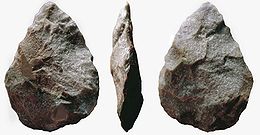
Acheulean handaxe, a type of stone tool named for the place where the earliest finds were made in the 1830s at St. Acheul, France (Wikipedia, accessed 27 December 2021)
A native of Trenton, Dr. Abbott was a physician who studied medicine at the University of Pennsylvania where he received his M.D. in 1865. Other than his service as a surgeon in the Civil War, he did not practice medicine professionally. Instead, he settled along the banks of the Delaware River at Trenton to become a gentleman farmer. His homestead is known as Marshlands and is today the Abbott Farm District National Historic Landmark. It was at Marshlands that Dr. Abbott wrote more than 20 books on fossil animals, archaeology, and nature. He is known today, however, chiefly for his archaeological discoveries. In the 1870s and 1880s fluvial terraces of the Delaware River called the Trenton Gravels were being exposed as roads, bridges, and railroads were being built. The exposed terraces were searched by Dr. Abbott and he found large rudely flaked stone tools in them that resembled the Acheulean handaxes being found in Europe. He called the stone tools from the Trenton Gravels “paleoliths” and claimed that they were evidence of prehistoric humans in the region during the glacial period, in other words, an American Palaeolithic.
Dr. Abbott believed that the American Palaeolithic was the same cultural phenomenon as the Palaeolithic of the Old World, and in his view it was evidence that North America had been inhabited by humans in the vast primeval antiquity of the world. The dramatic discovery of paleoliths in the Trenton Gravels was accepted by the American public and by scientists at home and abroad. His great discovery was enough to secure appointments for him as assistant curator of the Peabody Museum at Harvard (1876-1889) and as the first curator of the University of Pennsylvania’s Department of American Archaeology in the 1890s. His fame at the time was similar to another archaeologist, Dr. Heinrich Schliemann, whose exciting reports in the popular American press about his discoveries at Troy in the 1870s jostled with Dr. Abbott’s reports of the American Palaeolithic.
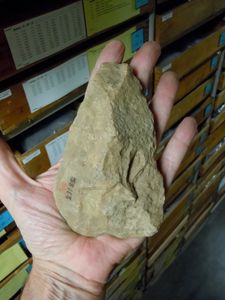
One of Dr. Abbott’s “paleoliths” from the Trenton Gravels curated at the Peabody Museum at Harvard.
But there were doubts, which were expressed forcefully in the 1890s by William Henry Holmes of the Bureau of American Ethnology at the Smithsonian Institution who represented a new breed—the professional archaeologist. Holmes challenged Abbott’s finds, arguing that he was far from diligent in recording the details of findspots and other details of his fieldwork. Though Abbott claimed to have found paleoliths within glacial deposits, for instance, he did not publish the documentation of the stratigraphic context necessary for archaeologists to be able to verify his finds. A tireless advocate of careful fieldwork and observation, William Henry Holmes was concerned enough to have a student do a test excavation for a few weeks in one of the Trenton gravel deposits, and when the student failed to find paleoliths in the deposits Holmes rejected the whole of Dr. Abbott’s American Paleolithic and launched an attack on the concept. He criticized Abbott’s methods, his interpretations, and—perhaps unnecessarily—Abbott himself, whom Holmes considered to be an old-fashioned amateur naturalist lacking in scientific training and method. And thus began what David Meltzer has called the Great Palaeolithic War, which ended with a complete victory for Holmes and the repudiation of Abbott’s discoveries. The American Palaeolithic was erased from textbooks in the 1890s and disappeared from public view until the 1920s when other discoveries of human activity dating back to the end of the Pleistocene, namely the Clovis and Folsom cultures in New Mexico, brought it back in a revised form. This partial vindication of Dr. Abbott’s views came a decade after his death.
The story does not end there. Perhaps Holmes too was mistaken? In his zeal to overthrow what he believed were the amateurish misinterpretations of archaeological evidence by Abbott, Holmes may have thrown the baby out with the bathwater. He argued that Abbott’s paleoliths were not Acheulean handaxes but lithic “preforms,” roughly worked pieces of stone that were intended to be turned into projectile points (such as small arrowheads), which had been made by Indigenous people no more than a couple of centuries ago. In other words, paleoliths were not finished tools but only the discarded debris left over from the manufacture of other artifacts.
To lay to rest the American Palaeolithic once and for all, Holmes conducted excavations at a site called Piney Branch in Washington, D.C. where he interpreted the finds as proving that the so-called paleoliths were nothing more than unfinished debris (Holmes called them “mere trash”) from a quarry workshop. After a reexamination of Holmes’ published results from Piney Branch, however, I found that his claim that all paleoliths were quarry debris is not as well supported by the evidence as Holmes would have us believe. Some of the pieces at Piney Branch may have been finished tools just as Dr. Abbott claimed. They may have been used on the site which was possibly occupied and used by Indigenous peoples for long periods of time, perhaps 4,000 years or more.
The idea that paleoliths could be stone tools in their own right, even if they are not chronologically or culturally the same thing as the Old World Palaeolithic, needs to be investigated further. Recent archaeological research in the arid west, for example, has shown that stone tools similar to Dr. Abbott’s paleoliths (handaxe-like forms) are found on lithic sites from Wyoming to northern Mexico where they appear to be tools used for purposes such as butchering wild animals. Add the discovery of new evidence for an American Palaeolithic such as the footprints from White Sands, New Mexico dated to 21-23 thousand years ago and the Cerutti Mastodon Site in San Diego dated to 130,000 years ago and one can wonder if Dr. Abbott hadn’t been right after all. Even during the Great Palaeolithic War some scholars were not convinced by Holmes’ arguments concerning the Trenton paleoliths. Frederick Ward Putnam, for example, who has been called the Father of American Archaeology, and who was the Curator of the Peabody Museum at Harvard, believed that his friend and colleague Dr. Abbott had indeed found finished tools in glacial contexts, not recent quarry rejects. On the strength of this conviction, Putnam appointed Dr. Abbott as Assistant Curator at the Peabody Museum and accepted Dr. Abbott’s collections of artifacts for the Museum, some 20,000 of them, which include artifacts representing a wide sweep of pre-Columbian cultural history along the Delaware. So as the Great Palaeolithic War was ending, seemingly with a complete victory for Holmes, Putnam wanted to get to the bottom of the paleolith problem. For two decades he supported the work of the archaeologist Ernest Volk who re-investigated the archaeology of the Delaware River valley and the Trenton gravels. Volk was a careful archaeologist who took his time to sort out what was in fact a knotty stratigraphical jumble made worse by the rapid pace of development and urban expansion in the area that was destroying the geological and archaeological record before his eyes. Volk published a final report in 1911 with evidence that stone tools were in fact found within glacial-age gravels as Dr. Abbott had claimed. But it was too late. No one was interested in the Trenton paleoliths by then. Putnam died in 1915, and Abbott and Volk died in 1919. William Henry Holmes outlived them all and was able to hold the line against any temptation to revive the American Palaeolithic, and by the time he died in 1933 Abbott’s American Palaeolithic was nothing but a short footnote to Holmes’ brilliant career.
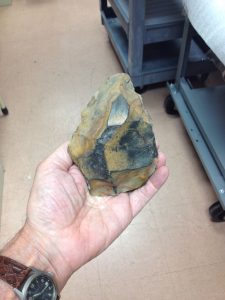
Questions remain unanswered about the Trenton Gravel finds. Are Dr. Abbott’s paleoliths ancient artifacts, quarry preforms, or some other late historic tool like Middle Woodland hoes? Are they found within the gravel deposits at Trenton, and thus of glacial age, or are they surface finds from recent periods of cultural activity? I have examined Dr. Abbott’s paleoliths in the Peabody Museum and the New Jersey State Museum in Trenton and they appear to be tools as Dr. Abbott believed. He left notes claiming to have found particular specimens, like the one pictured here, within undisturbed gravel deposits of glacial age, but unfortunately, we have only his word for this. New fieldwork would have to be done at Trenton in order to address these questions and this is not likely to happen anytime soon. On a visit to Trenton in 2011 it was obvious that the research necessary to understand the archaeology of the Trenton Gravels would be difficult to do. Development and urban sprawl have accelerated since Volk’s day, and the geologic deposits that were exposed in Dr. Abbott’s time in the course of massive infrastructure projects are no longer available for study. The view over the Delaware River from the Trenton Morrisville Bridge makes the archaeologist’s heart sink. What isn’t under roads, buildings, factories, and parking lots is covered with dense vegetation and all but invisible. For all intents and purposes, Dr. Abbott’s “Palaeolithic” sites are gone. At least for the time being, Dr. Abbott’s last case remains unsolved.
Further Reading
Charles C. Abbott, 1876, “The Stone Age in New Jersey,” Annual Report of the Smithsonian Institution 1875. Government Printing Office, Washington D.C., pp. 246-380.
Clive Gamble, 2021, Making Deep History: Zeal, Perseverance, and the Time Revolution of 1859. Oxford University Press.
David J. Meltzer, 2015, The Great Paleolithic War: How Science Forged an Understanding of America’s Ice Age Past. University of Chicago Press. https://doi:9780226293363.001.0001
Curtis Runnels, 2020, “The Piney Branch Site (District of Columbia, USA) and the Significance of the Quarry-Refuse Model for the Interpretation of Lithics Sites,” Journal of Lithic Studies 7 (1): 1 – 17. https://doi.org/10.2218/jls.2986
Ernest Volk, 1911, The Archaeology of the Delaware Valley. Peabody Museum, Cambridge Massachusetts.