Dr. Charles Conrad Abbott and the Curious Case of the American Palaeolithic

Apart from historically-minded citizens of Trenton, New Jersey, the name of Dr. Charles Conrad Abbott has been forgotten. This was not always the story, for once upon a time Dr. Abbott, a naturalist and amateur archaeologist, was a popular writer and was hailed as the Father of Prehistoric America. What happened?

The prehistoric antiquity of humans was recognized in 1859—a year known as the annus mirabilis—with the acknowledgement by archaeologists, geologists, and paleontologists that stone tools in Europe occurred in direct association with the fossilized remains of extinct animals like mammoths in very old geologic deposits laid down in the Pleistocene (aka the last Ice Age). These stone tools were denominated by archaeologists as Palaeolithic (Old Stone Age) and examples of them, such as the iconic Acheulean handaxe, were recognized in glacial deposits throughout Europe. By the 1870s reports were common of similar finds in lands around the Mediterranean and in Southwest Asia and it seemed likely that evidence of Palaeolithic humans would be found throughout the world. Thus reports of Palaeolithic stone tools in the United States that appeared in 1872 seemed credible. And the credit for their discovery belonged to Dr. Charles Conrad Abbott.
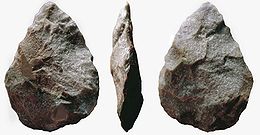
Acheulean handaxe

Acheulean handaxe, a type of stone tool named for the place where the earliest finds were made in the 1830s at St. Acheul, France (Wikipedia, accessed 27 December 2021)

A native of Trenton, Dr. Abbott was a physician who studied medicine at the University of Pennsylvania where he received his M.D. in 1865. Other than his service as a surgeon in the Civil War, he did not practice medicine professionally. Instead, he settled along the banks of the Delaware River at Trenton to become a gentleman farmer. His homestead is known as Marshlands and is today the Abbott Farm District National Historic Landmark. It was at Marshlands that Dr. Abbott wrote more than 20 books on fossil animals, archaeology, and nature. He is known today, however, chiefly for his archaeological discoveries. In the 1870s and 1880s fluvial terraces of the Delaware River called the Trenton Gravels were being exposed as roads, bridges, and railroads were being built. The exposed terraces were searched by Dr. Abbott and he found large rudely flaked stone tools in them that resembled the Acheulean handaxes being found in Europe. He called the stone tools from the Trenton Gravels “paleoliths” and claimed that they were evidence of prehistoric humans in the region during the glacial period, in other words, an American Palaeolithic.

Dr. Abbott believed that the American Palaeolithic was the same cultural phenomenon as the Palaeolithic of the Old World, and in his view it was evidence that North America had been inhabited by humans in the vast primeval antiquity of the world. The dramatic discovery of paleoliths in the Trenton Gravels was accepted by the American public and by scientists at home and abroad. His great discovery was enough to secure appointments for him as assistant curator of the Peabody Museum at Harvard (1876-1889) and as the first curator of the University of Pennsylvania’s Department of American Archaeology in the 1890s. His fame at the time was similar to another archaeologist, Dr. Heinrich Schliemann, whose exciting reports in the popular American press about his discoveries at Troy in the 1870s jostled with Dr. Abbott’s reports of the American Palaeolithic.
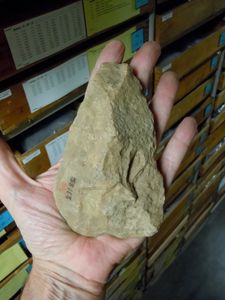
Abbott paleolith

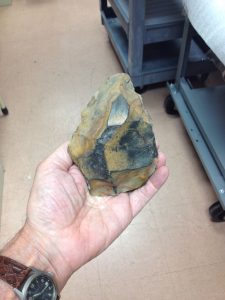
One of Dr. Abbott’s “paleoliths” from the Trenton Gravels curated at the Peabody Museum at Harvard.

But there were doubts, which were expressed forcefully in the 1890s by William Henry Holmes of the Bureau of American Ethnology at the Smithsonian Institution who represented a new breed—the professional archaeologist. Holmes challenged Abbott’s finds, arguing that he was far from diligent in recording the details of findspots and other details of his fieldwork. Though Abbott claimed to have found paleoliths within glacial deposits, for instance, he did not publish the documentation of the stratigraphic context necessary for archaeologists to be able to verify his finds. A tireless advocate of careful fieldwork and observation, William Henry Holmes was concerned enough to have a student do a test excavation for a few weeks in one of the Trenton gravel deposits, and when the student failed to find paleoliths in the deposits Holmes rejected the whole of Dr. Abbott’s American Paleolithic and launched an attack on the concept. He criticized Abbott’s methods, his interpretations, and—perhaps unnecessarily—Abbott himself, whom Holmes considered to be an old-fashioned amateur naturalist lacking in scientific training and method. And thus began what David Meltzer has called the Great Palaeolithic War, which ended with a complete victory for Holmes and the repudiation of Abbott’s discoveries. The American Palaeolithic was erased from textbooks in the 1890s and disappeared from public view until the 1920s when other discoveries of human activity dating back to the end of the Pleistocene, namely the Clovis and Folsom cultures in New Mexico, brought it back in a revised form. This partial vindication of Dr. Abbott’s views came a decade after his death.

The story does not end there. Perhaps Holmes too was mistaken? In his zeal to overthrow what he believed were the amateurish misinterpretations of archaeological evidence by Abbott, Holmes may have thrown the baby out with the bathwater. He argued that Abbott’s paleoliths were not Acheulean handaxes but lithic “preforms,” roughly worked pieces of stone that were intended to be turned into projectile points (such as small arrowheads), which had been made by Indigenous people no more than a couple of centuries ago. In other words, paleoliths were not finished tools but only the discarded debris left over from the manufacture of other artifacts.

To lay to rest the American Palaeolithic once and for all, Holmes conducted excavations at a site called Piney Branch in Washington, D.C. where he interpreted the finds as proving that the so-called paleoliths were nothing more than unfinished debris (Holmes called them “mere trash”) from a quarry workshop. After a reexamination of Holmes’ published results from Piney Branch, however, I found that his claim that all paleoliths were quarry debris is not as well supported by the evidence as Holmes would have us believe. Some of the pieces at Piney Branch may have been finished tools just as Dr. Abbott claimed. They may have been used on the site which was possibly occupied and used by Indigenous peoples for long periods of time, perhaps 4,000 years or more.

The idea that paleoliths could be stone tools in their own right, even if they are not chronologically or culturally the same thing as the Old World Palaeolithic, needs to be investigated further. Recent archaeological research in the arid west, for example, has shown that stone tools similar to Dr. Abbott’s paleoliths (handaxe-like forms) are found on lithic sites from Wyoming to northern Mexico where they appear to be tools used for purposes such as butchering wild animals. Add the discovery of new evidence for an American Palaeolithic such as the footprints from White Sands, New Mexico dated to 21-23 thousand years ago and the Cerutti Mastodon Site in San Diego dated to 130,000 years ago and one can wonder if Dr. Abbott hadn’t been right after all. Even during the Great Palaeolithic War some scholars were not convinced by Holmes’ arguments concerning the Trenton paleoliths. Frederick Ward Putnam, for example, who has been called the Father of American Archaeology, and who was the Curator of the Peabody Museum at Harvard, believed that his friend and colleague Dr. Abbott had indeed found finished tools in glacial contexts, not recent quarry rejects. On the strength of this conviction, Putnam appointed Dr. Abbott as Assistant Curator at the Peabody Museum and accepted Dr. Abbott’s collections of artifacts for the Museum, some 20,000 of them, which include artifacts representing a wide sweep of pre-Columbian cultural history along the Delaware. So as the Great Palaeolithic War was ending, seemingly with a complete victory for Holmes, Putnam wanted to get to the bottom of the paleolith problem. For two decades he supported the work of the archaeologist Ernest Volk who re-investigated the archaeology of the Delaware River valley and the Trenton gravels. Volk was a careful archaeologist who took his time to sort out what was in fact a knotty stratigraphical jumble made worse by the rapid pace of development and urban expansion in the area that was destroying the geological and archaeological record before his eyes. Volk published a final report in 1911 with evidence that stone tools were in fact found within glacial-age gravels as Dr. Abbott had claimed. But it was too late. No one was interested in the Trenton paleoliths by then. Putnam died in 1915, and Abbott and Volk died in 1919. William Henry Holmes outlived them all and was able to hold the line against any temptation to revive the American Palaeolithic, and by the time he died in 1933 Abbott’s American Palaeolithic was nothing but a short footnote to Holmes’ brilliant career.

Questions remain unanswered about the Trenton Gravel finds. Are Dr. Abbott’s paleoliths ancient artifacts, quarry preforms, or some other late historic tool like Middle Woodland hoes? Are they found within the gravel deposits at Trenton, and thus of glacial age, or are they surface finds from recent periods of cultural activity? I have examined Dr. Abbott’s paleoliths in the Peabody Museum and the New Jersey State Museum in Trenton and they appear to be tools as Dr. Abbott believed. He left notes claiming to have found particular specimens, like the one pictured here, within undisturbed gravel deposits of glacial age, but unfortunately, we have only his word for this. New fieldwork would have to be done at Trenton in order to address these questions and this is not likely to happen anytime soon. On a visit to Trenton in 2011 it was obvious that the research necessary to understand the archaeology of the Trenton Gravels would be difficult to do. Development and urban sprawl have accelerated since Volk’s day, and the geologic deposits that were exposed in Dr. Abbott’s time in the course of massive infrastructure projects are no longer available for study. The view over the Delaware River from the Trenton Morrisville Bridge makes the archaeologist’s heart sink. What isn’t under roads, buildings, factories, and parking lots is covered with dense vegetation and all but invisible. For all intents and purposes, Dr. Abbott’s “Palaeolithic” sites are gone. At least for the time being, Dr. Abbott’s last case remains unsolved.

Further Reading

Charles C. Abbott, 1876, “The Stone Age in New Jersey,” Annual Report of the Smithsonian Institution 1875. Government Printing Office, Washington D.C., pp. 246-380.

Clive Gamble, 2021, Making Deep History: Zeal, Perseverance, and the Time Revolution of 1859. Oxford University Press.

David J. Meltzer, 2015, The Great Paleolithic War: How Science Forged an Understanding of America’s Ice Age Past. University of Chicago Press. https://doi:9780226293363.001.0001

Curtis Runnels, 2020, “The Piney Branch Site (District of Columbia, USA) and the Significance of the Quarry-Refuse Model for the Interpretation of Lithics Sites,” Journal of Lithic Studies 7 (1): 1 – 17. https://doi.org/10.2218/jls.2986

Ernest Volk, 1911, The Archaeology of the Delaware Valley. Peabody Museum, Cambridge Massachusetts.
The Lost Site of Blacks Fork

In the summer of 2017 in the last days of innocence before the plague would blight our days, we found ourselves in southwestern Wyoming searching for a lost archaeological site. Discovered in the late 1930s, the site’s precise location had slipped away. The archaeologist provided only a rough sketch map of the location and no photographs of the site or its surroundings. Even more confusingly, the roads and monuments used on the sketch map for reference had been changed during road construction in the 1980s.

The site is important because it was once the center of an archaeological controversy, one that is being revived today. It is not an eye-catching ruin: it consists of large numbers of flaked stone tools made from chert scattered along the highest Pleistocene (last Ice Age) terrace of the Blacks Fork River a few miles from the historic site of Fort Bridger on the emigrant trail that led to Utah, California, and Oregon.

The site was discovered by the archaeologist E. B. Renaud, who has also slipped from view. Renaud was based at the University of Denver in Colorado where he specialized in the study of the earliest cultures in the United States and is perhaps best known, if at all, for the discovery of the site at Blacks Fork.

Renaud explored the Rocky Mountain states in the 1920s and 1930s following the discovery of the Folsom culture in New Mexico in 1926 that resulted in the recognition that early humans were in North America in the Pleistocene more than 10,000 years ago. He conducted numerous archaeological surveys and excavations that resulted in more than 100 publications.

In 1935 Renaud and his team surveyed the terraces of the Blacks Fork in response to a tip from local amateur archaeologists. E. B. (as he was known) was surprised by what he found. The stone tools along the terrace were not like the commonly known artifacts made by the indigenous peoples of North America in the last 10,000 years. They resembled instead the types of artifacts found in Africa and Europe that belong to the early Palaeolithic dating back more than 100,000 years. Though E. B. was unable to date the site, he knew that if the artifacts were Palaeolithic the Blacks Fork Culture (as he called it) could be a vestige of the earliest inhabitants of the Americas.

E. B. collected nearly 1,000 artifacts from Blacks Fork between 1935 and 1938 which are stored today in the Museum of Anthropology at the University of Denver (where we studied them in 2015). He published his findings and even took specimens to Europe to show to Palaeolithic specialists in an effort to confirm his findings. For a brief time the Blacks Fork Culture was the center of archaeological speculation about the peopling of the New World. This fame did not last: most research on the topic came to a halt during the Second World War and was slow to resume afterwards. Then a new idea, today called the Clovis First model, took hold. The Clovis First model posits that people only entered North America once, about 12,000 years ago, by crossing the Beringian land bridge from Siberia to Alaska and traversing an Ice Free Corridor in the glaciers to reach the lower 48 states of the US. An early Palaeolithic culture simply did not fit this model and the Blacks Fork Culture disappeared from the literature on the early prehistory of the Americas. Renaud retired in 1948 and was either unable or was unwilling to pursue his research at Blacks Fork. The publications would rest on library shelves and the artifacts in their boxes in the museum for 75 years. Even the location of the site was forgotten.

Who was E. B.? Etienne Bernardeau Renaud was born in Billancourt-Bologne, France, in 1880. He studied anthropology, paleontology and primitive art at the University of Paris before immigrating to the United States in 1909 (he became a citizen in 1913). He taught French in Santa Fe and studied at the Catholic University of Washington. In 1916 he returned to France as a soldier. He returned to Denver to earn a PhD in Anthropology at the University of Colorado in Boulder and in 1920 he became a lecturer at the University of Denver where he helped establish the Department of Anthropology. In 1923 he became Professor of Anthropology, and in 1931 he founded the Denver University Museum of Anthropology. E. B was also the French Consular Agent in Denver, for which service he received a medal from France. Professor Renaud died in 1973.

We are intrigued by Renaud’s background because his training and experience with Palaeolithic sites in Europe make it unlikely that his identification of the Blacks Fork artifacts was simply a mistake. He studied archaeology during a period when France was a leader in the field of Palaeolithic archaeology, and he returned several times to Europe in the 1920s and 1930s to keep in touch with the latest developments. During these trips he visited sites and studied museum collections. Photographs in the Renaud Archive show him at key sites like Le Solutré, Le Moustier, Laugerie Haute, La Micoque, and La Ferrassie in France, Spy in Belgium, Krapina in Croatia, and Ipswich in England. He had a keen interest in the archaeology of the cultures of the Neanderthals and early modern humans in the Palaeolithic from roughly 250 to 15 thousand years ago and had hands-on experience with their characteristic stone tools.

Our investigation began with a visit to the Museum of Anthropology at the University of Denver to study the artifacts. We were surprised by what we discovered: E. B. had been right, at least in so far as the artifacts are indeed similar in form and method of manufacture to artifacts from the Palaeolithic cultures from Africa, Europe, and much of Asia. For example, there are large almond-shaped tools called handaxes (and a suite of stone tools that go with the handaxes called picks, cleavers, massive scrapers, and choppers), as well as pointed flakes struck from carefully prepared and shaped cores (called the Levallois technique). Archaeological methods, including the ways that stone tools are classified, have changed since E. B.’s time, yet our analysis showed these tool types, especially because they occur in coherent groups we can call “toolkits,” would be regarded as “Palaeolithic” if they were found along the banks of the Seine River in France rather than a remote outpost in Wyoming. The similarities of the Blacks Fork artifacts to Palaeolithic types is a controversial claim, but we believe that it should be taken seriously and investigated further.

There is a catch. E. B. was unable to assign the Blacks Fork Culture to a particular period of time because the artifacts are not found in layers that can be dated. They are found embedded in what are called desert pavements, layers of rocks that form hard surfaces and which have been created by natural processes. The location of the desert pavements on an old terrace that dates to the Pleistocene is suggestive—but not proof—of a great age for the artifacts. The fact remains, however, that they are “floating in time.” There is evidence that some of the distinctive characteristics of the Blacks Fork artifacts can also be found among the earliest sites in the region, like Cooper’s Ferry in Idaho that is dated to 16,000 years ago. That is old, but not as old as the Palaeolithic in the Old World.

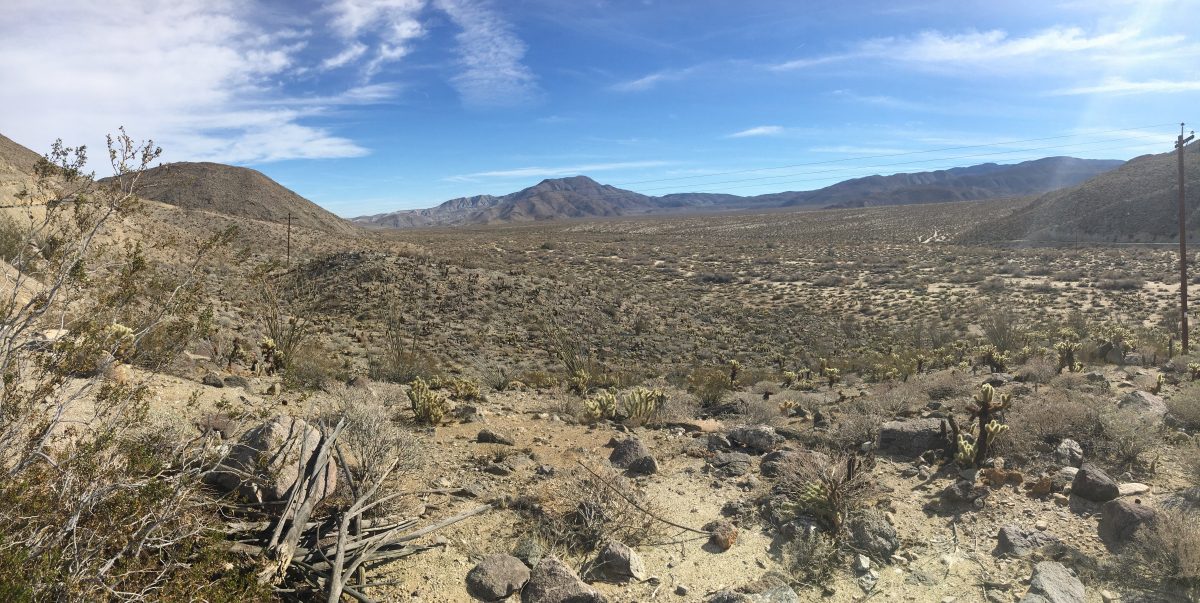
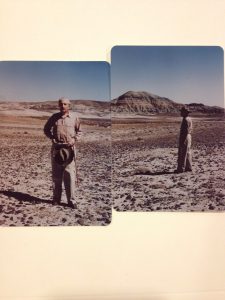
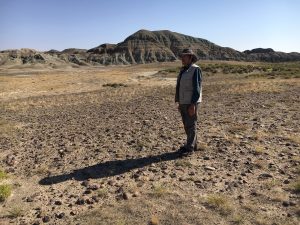
The next step was to find the site. While we were at the University of Denver preparing a report on the stone tools we went through E. B.’s papers stored in the University’s Special Collections. In a box we found two photographs that showed E. B. standing in a barren western landscape, and on the back of one the pencilled notation of a site number. It happened to be the Blacks Fork type site. That photograph brought us to Wyoming where at Fort Bridger the helpful park docents explained how the roads and monuments on E. B.’s original sketch map showing the location of the site were no longer in the same locations. With their help we were able to reconcile the old map with a modern map and, after some back and forth searching, we found the exact spot where E. B. was standing and where, triumphantly, I assumed the same position as in E. B.’s photograph to fix the location.

What have we found and what is the significance of the Blacks Fork Culture today? Since the mid-1990s archaeologists have been moving gradually away from the Clovis First model and considering the possibility that humans may have arrived in the Americas much earlier in time. The Blacks Fork Culture may help to form a new picture of the spread of the first peoples in the Americas. This is not yet possible. Much new research must be done. At present our working hypothesis is that the Blacks Fork Culture may have been produced by early humans who brought with them a broadly Eurasian “Blueprint” for making simple tools necessary for hunting, foraging, and gathering, a type of stone tool culture that may have given rise to archaeological cultures like the Western Stemmed Tradition found at Cooper’s Ferry. How old is the Blacks Fork Culture? At present we have no way of knowing. It is time to dust off E. B.’s old notes and artifacts and pick up the story where he left it off on the banks of the Blacks Fork River.

Further Reading:

Curtis Runnels and Priscilla Murray, 2022, “The Blacks Fork Culture of Southwestern Wyoming: Quarry Refuse or a Lithic Culture?” in George Jefferson, Steven R. Holen, and Kathleen A. Holen, eds., New Discoveries in the American Paleolithic, pp. 95-108.  San Diego, California: Sunbelt Publications.

EB at Blacks Fork (undated photographs from Special Collections, University of Denver)

EB at Blacks Fork

CR at Blacks Fork

CR at Blacks Fork

Blacks Fork handaxe

Blacks Fork handaxe 1

Ann Axtell Morris, Archaeologist of the Southwest

Lovers of archaeology are in for a treat. Following the success of The Dig, a British film that chronicles the excavation of the Sutton Hoo burial in England in 1939, an American archaeologist is now coming to your favorite streaming device. Film crews are wrapping up their work in the Canyon de Chelly National Monument in Arizona on the film Canyon del Muerto about the life and work of the undeservedly-forgotten archaeologist Ann Axtell Morris (1900-1945), in the 1920s and 1930s. The movie is slated for release this year.

Ann Axtell Morris' book on her Southwestern archaeological experiences

Why make a movie about Ann Axtell Morris? Good reasons are found in her only publications, two books written for general readers, Digging in Yucatan, and Digging in the Southwest, which I discuss here. Her course through archaeology was meteoric, rising fast and high, and burning out all too soon. From her home in Nebraska, she went to Smith College in Massachusetts to study history, and then to France for a year to study prehistoric archaeology. Her goal was to do archaeological research in the American Southwest, a region that she thought had been sadly neglected archaeologically. At the precocious age of 23 she was able to achieve her goal after her marriage to the archaeologist Earl Morris, with whom she pursued field archaeology in all its many moods for two decades from the Yucatan in Mexico to the Ancestral Puebloan ruins in the Canyon de Chelly in Arizona (of which the Canyon del Muerto of the film’s title is a part). Sadly, the last ten years of her life saw a steady decline in her health ending in an untimely death, and today her notable achievements as a field archaeologist have been almost totally obliterated by time. I hope Canyon del Muerto will awaken interest in this pioneering archaeologist, and that her popular books will bring her knowledge and ability within reach of a new generation of readers.

Ann and Earl Morris worked on sites from Chichen Itza in the Yucatan to Mummy Cave in the Canyon del Muerto for two decades and achieved outstanding results which are unfortunately all but buried in technical reports (some of which incorporated Ann’s accomplished watercolors). There is nothing remarkable about this bare résumé; the first half of the 20th century was after all one of the most romantic periods of archaeological research and is a vast tale of great discoveries and colorful characters, often forgotten today. What makes Ann Morris stand out (apart from being a pioneering and successful woman archaeologist in a field dominated at the time by men) is the person who emerges from her books.

Ann Morris was a superb English stylist, remarkably so for such a young writer, and she tells her story with enthusiasm and excitement. Her prose has an immediacy that reminds one of an informal snapshot taken by a Kodak Brownie camera, as opposed to the serious formal posing required for studio photography. Her prose flows like a southwestern arroyo after a thunderstorm, and has a freshness that makes it a book of the sunlight outdoors in an Arizona desert, rather than a text composed in an academic study that “smells of the lamp.” She attempts to explain to her reader what archaeologists have found, their sites, and artifacts, monumental architecture, and art, but above all she wants to tell readers what archaeological fieldwork was like (as opposed to academic or literary archaeology). A few select (lightly edited) quotes from Digging in the Southwest (published by Doubleday, Doran & Co., Garden City, New York, 1934) will give the flavor of her writing. I feel like saying “selected at random” because there were so many rich pages that could have been mined for nuggets. She tells us what archaeology is, “archaeology might be defined as a rescue expedition sent into the far places of the earth to recover the scattered pages of man’s autobiography”(p. xv), and what were its goals, “instead of being tethered within the small present, bounded on one side by a hazy tomorrow and on the other by a very few centuries of carefully dated yesterdays, the long stream of human existence can be traced ever backward through the millennia…ever backward, the trail runs, and it is given to the archaeologist to trace its way” (p. xvii). After noting that America’s rich claim to antiquity were buried in blind oblivion, she goes on to say “then came the Archaeologists! Like a species of industrious gophers, they have spread from Alaska to Patagonia. They dig and they pry and they probe. They photograph and they map and they measure. Lost cities are being found again, fallen temples are being rebuilt, and broken pottery is being mended…each one has taken it on himself to restore some small fraction of long-lost history to its rightful place” (p. 6). And finally, “[the goal of archaeology] may have been achieved and may have been a thrilling one, but…[the] method and meticulous points of prosy detail are enshrined in vast scientific tomes which but few people ever see and fewer have the tenacity to read. One receives a most unfortunate and false impression that archaeology is not really half as much fun as it ought to be, and that archaeologists are dry things, squeezed empty of all human qualities. Now I for one know better, for I have been and I have seen” (p. 10). And so she has.

I hope that this film will be a success and that Ann Morris’ books will delight a new generation of readers. Today they are very rarely seen on the secondhand book market. Yet they are among the best accounts of the thrill of archaeological exploration and faithfully and amusingly capture the romance of archaeology in an era that is becoming something of an “ancient artifact.” Though Ann was ahead of her time in many ways and wrote thoughtfully about the Indigenous peoples with whom she worked, her cavalier attitude to prehistoric human remains is no longer acceptable. And of course, the culture history is well done but is now obsolete, as is to be expected after a further century of fieldwork in the area. We must accept the books for what they are, and not for what they should be, because they succeed in telling the story of archaeological research with such verve and attention to telling detail that one can almost smell the smoke from the campfires, hear the excitement in the voices of the archaeologists, and feel the heat of the desert as the summer clouds pile up on the western horizon.