February 16, 2022 at 3:10 pm
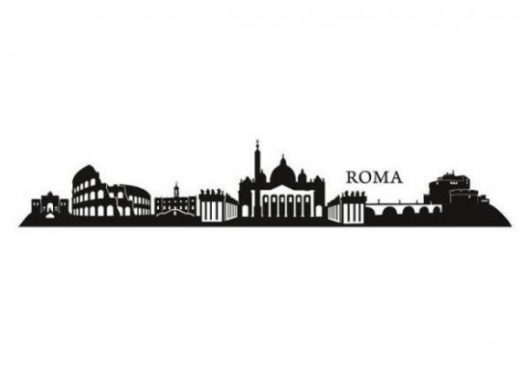
On Tuesday, February 15 2022, Professor Swen Voekel gave his lecture on monumentalism in Ancient Rome. This lecture was given to CC102 students as historical context to their current assigned text, Virgil's Aeneid. Along with his presentation, Professor Voekel provided a list of what he described as "some really entertaining, visually stimulating stuff that is also very good in terms of scholarly content." Interested in how a Roman teenager would spend their day? What about seeing the layout of the land around the Colosseum not as it is today, but as it was during the rule of Constantine? This compilation of educational materials range from TED Talks to articles to interactive virtual recreations of Rome circa 320 CE. All of Professor Voekel's generously provided audio-visual resources are listed below for any Aeneid readers, or anyonesimplycurious about Ancient Rome, to peruse.
Videos:
Ancient Rome in 20 minutes--an entertaining crash course video by Arzamas.
History vs. Augustus: The Roman Emperor on trial--visionary leader or tyrant? Excellent Ted-Ed cartoon debates a key figure in Roman history.
Augustus:Rome's Greatest Emperor--from Biographics, this video has nearly 2 million views.
Classics Summarized: The Aeneid. By Overly Sarcastic Productionsname says it allentertaining, but take it with a grain of salt.
A day in the life of a Roman soldier - Robert Garland TED-Ed cartoon, by leading classical scholar Garland.
Four sisters in Ancient Rome Ray Laurence - TED-Ed cartoon, good on the roles (or lack thereof) of women in Rome
A glimpse of teenage life in ancient Rome Ray Laurence - TED-Ed cartoon.
Meet The Romans with Mary Bearda series by Timeline: World History Documentaries, with leading ancient Roman historian Beard.
Les Nocturnes du Plan de Rome: Le Capitole (Capitol Hill)excellent tour of lovingly reconstructed virtual Rome by two French professors (tour itself begins about half-way through video(note: Professor Voekel mentions that "there are many of these virtual tours, all very entertaining and scholarly. In French, but I could follow it with my shaky intermediate grasp of the language."
Compilations:
Videos and articles from Khan Academy on ancient Rome.
Smarthistory Ancient Rome from the Center for Public Art Historytons of video and short, accessible articles on the art, architecture and history of ancient Rome.
Avery interesting discussion of the statue Augustus of Prima Porta, also from Smarthistory.
Virtual Tours:
An especiallycool virtual tour of Rome in 320 CE.
Digital Augustan Rome: interactive map of the city c. A.D. 14.(this link doesn't seem to be working)
Interactive Models of Archaic and Imperial Rome from the Museo della Civilt Romana via Google Arts and Culture (part 1)
Interactive Models of Archaic and Imperial Rome from the Museo della Civilt Romana via Google Arts and Culture (part 2)
All of these great sources from Professor Voekel gives students a wide variety of supplementary materials on Ancient Rome to benefit from. Let us know which of these was your favorite, or if you have any other content you'd like to share!
By CAS Core Curriculum
|
Posted in Academics, Core Lecturers, Curriculum, Other Publications
|
February 9, 2022 at 9:50 am
W. Robert Connor, a professor of classics emeritus at Princeton University and director emeritus of the National Humanities Center, found insight into our society's future from a narrative of the pandemic in Athens. In his reading of Thucydides'sHistory of the Peloponnesian War,he found himself considering the full impact of COVID-19 beyond its tolls on our physical health. He wrote, "Covid-19 seems to attack society as a whole the same way it does individuals: whenever possible it finds preexisting conditions, exacerbates them, and thereby takes its toll."
Read the full article here:https://theamericanscholar.org/reading-thucydides-in-a-time-of-pandemic/?utm_source=email
By CAS Core Curriculum
|
Posted in Uncategorized
|
February 4, 2022 at 12:36 pm
Two books we wanted to bring to your attention!
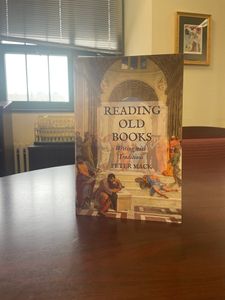
First: Peter Mack's "Reading Old Books," which explores the creative power of literary tradition spanning from the middle ages up until the twenty-first century.Mack argues that the best way to understand tradition is to study the moments when a writer purposefully puts their work in conversation with a writer that came before them. Mack investigates authors such as Chaucer, Ariosto, Spenser, and Elizabeth Gaskell among others. The book is currently available to be borrowed from the Core library and can also be purchased at the link below.
https://press.princeton.edu/books/hardcover/9780691194004/reading-old-books
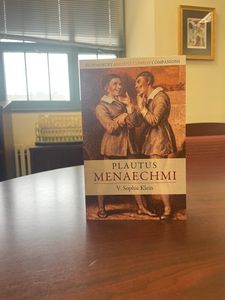
Additionally, check out this new translation of Plautus' Menaechmi done by our very own Professor Sophie Klein. This ancient comedy is a tale of identical twin brothers who were separated at birth and reconnect as adults. The book explores the meanings of freedom and the social status of women and slaves in Roman culture. The book can be purchased at the link below.
https://www.bloomsbury.com/us/plautus-menaechmi-9781350092723/
By CAS Core Curriculum
|
Posted in Faculty Publications
|
February 3, 2022 at 4:06 pm
Check out this video de-bunking the myths around Homer! Who was our beloved "The Odyssey" actually written by?
https://www.youtube.com/watch?v=et5pkMNFrxU
By CAS Core Curriculum
|
Posted in Uncategorized
|
February 3, 2022 at 4:06 pm
Last spring, students in CC222 made TikTokson writers they read throughout the semester including Freud, Foucault, Butler, and others. A playlist of these videos can be found at the link below. Whoever said learning couldn't be fun?
https://www.youtube.com/playlist?list=PLwmHaVvbCV6pLVSuJRFWOxuwTCS-PBpiM
By CAS Core Curriculum
|
Posted in Uncategorized
|
February 1, 2022 at 1:32 pm
From the Instagram feed of our friends at BU's Elie Wiesel Center for Jewish Studies, we see a great feature about one of our new first-year humanities instructors, Dr. Matthew Creighton. From the post:
Introducing Matthew Creighton, the next feature of our#FacultyFridayseries.A Boston University graduate, Professor Creighton specializes in German literature, modern Jewish intellectual history, and theories of religion, secularization and modernity. He received his PhD in Religion and Literature from the University of Chicago's Divinity School. Here at the Elie Wiesel Center, Professor Creighton is a lecturer, as well as within the Writing Program and the Core Curriculum.This is Professor Creighton's first year at Boston University! This Spring Semester he is teaching CAS EN/JS/XL 126 "Jewish Diaspora" and CAS CI/JS/XL 367 "Holocaust Film". These courses fall into various CAS departments, showing the variety of knowledge that Professor Creighton is qualified to teach about. Stayed tuned to see what courses Professor Creighton will be teaching in the Fall Semester.Professor Creighton had published many works, ranging from articles to reviews. His doctoral dissertation is titled The Hidden Father and the Problem of Generations in Luther, Freud, and Kafka."
If you're interested in taking a class with Prof. Creighton next year, be sure to keep your eyes open for Core promotions for our fall course offerings. Join us in welcoming him to the faculty!
By CAS Core Curriculum
|
Posted in Uncategorized
|
January 19, 2022 at 3:24 pm
The following round-up of items of interest from BU'sBostonia magazine comes to us from alumna Cat Dossett (Core '16, CAS '18), an illustrator and writer living in the Boston area. For your interest and edification, here are their recommendations:
- The News section tells us that BU mechanical engineers are usingkirigamito create robotic grabby hands. What's kirigami, you ask?Think origami, but you cut the paper --kirirefers to cutting, andgamirefers to paper. Read more >>
- From the "We're reading" section comes a spotlight onFloating in a Most Peculiar Wayby Louis Chude-Sokei -- a professor of English, holder of the George and Joyce Wein Chair in African American Studies, and director of the African American Studies Program. This book was one of the titles which winners of the various Core awards in Spring 2021 were invited to choose as a prize to honor their achievements in the classroom and the Core community; Cat received her copy as a gesture of thanks for her contribution to that year's Core Journal as an alumni editor.Read more >>
- There's a new bust in town! Bostonia tells us about a new sculpture honoringElie Wiesel in the Human Rights Porch of the National Cathedral in Washington, DC. Wiesel, many readers will know, lectured in Core for a time. Michael Zank, a Core friend and lecturer, is quoted in the article. Sculptors employed medieval techniques to create this and other busts, like those of Rosa Parks and Howard Thurman. Cat remarks: "They look wonderful if a little surreal. Heads emerge from columns like wood-ear mushrooms..." Read more >>
- "These are very weird stars," says Prof. JJ Hermes.Lovely to see an astronomy article; too often we in the Core community forget about the natural sciences, as we grapple with Cervantes and Du Bois and Milton, but these disciplines are (and should be) a big part of Core. Read more >>
By zakbos
|
Posted in In the News, Other Publications
|
Tagged alumni, Bostonia, posts by Cat Dossett
|
December 9, 2021 at 10:49 am
Officials believe the artifact looted during the 1991 Gulf War was illegally imported into the U.S. in 2003, then sold and put on display in a Washington museum.
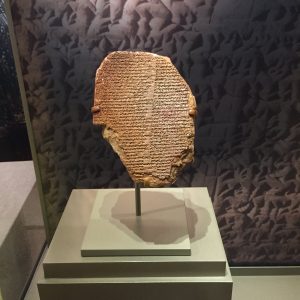
https://www.nbcnews.com/news/world/ancient-gilgamesh-tablet-showcasing-earliest-form-literature-returned-rcna8001
By CAS Core Curriculum
|
Posted in Uncategorized
|
 Issue Theme: “Age of Anxiety”