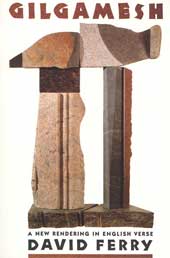
 To inaugurate the launch of the Core blog, Prof. David Eckel—Director of the Core Curriculum—conducted an interview with respected author and translator David Ferry, whose poetic rendering of Gilgamesh is the first book read by students in Core Humanities. What follows is the first half of that interview; the second half will be posted tomorrow.
David Eckel: Your friends and admirers know you as an eloquent and accomplished poet. You have written several successful volumes of poetry and a series of graceful translations from Latin authors, including Horace and Virgil. I wonder what first attracted you to the Mesopotamian tradition and the Epic of Gilgamesh.
David Ferry: I had a good friend, William Moran, who was the Assyriologist honcho at Harvard, a great scholar. He liked my poems and other translations and so he gave me his word-for-word translation of the great opening passage and also the passage in Tablet Six where Ishtar hits on Gilgamesh and he enrages her by telling her off as a divine mischief-maker and screwer up of things and listed what happened to her previous lovers, human, animal and divine. Making verse out of these got me going, once I’d found a suitable form, iambic pentameter couplets. I loved these passages so much that there was no turning back. Bill led me to other word-for-word scholarly translations, and I did the whole thing in a matter of months. Time of my life.
DE: Are there any passages in the Epic that you as a poet found particularly appealing?
DF: The only honest answer is, all of them, though each of them for different reasons. The great exciting terrifying and in some ways hilarious battle in the Cedar Forest; the heartbreaking death of Enkidu passage; Gilgamesh crossing the Sea of Death; the Flood passage, which must have influenced the Biblical account. Everything. What astonishes me is that this question can only be answered as “all of them.” The parade of scenes, each so different from the one before it: Ishtar trying to seduce Gilgamesh followed by the rich comic menacing scene between Ishtar and her father god Anu followed by the battle between Gilgamesh and Enkidu (and their men) and the Bull of Heaven, ending in the triumphant quietness of Gilgamesh and Enkidu in the palace, followed then by the gods in council and Enkidu’s sickness and death, and Gilgamesh’s grieving, and then in Tablet Eight the great elegy of mourning.
DE: Are there any passages that you found particularly challenging?
DF: Hard to answer this one. I guess, again, that one true answer is all of them. The other, though, is that line by line it was all less challenging than any experience of translating lines of Latin or French, which I “know.” I was working from scholarly word-for-word translations and these had the effect of being, in themselves, less nuanced and complex than I would have found the Babylonian, if I knew Babylonian. It was easier to invent my own nuances, based on my imagination’s understanding of what was going on in these characters and their situations. I don’t know if this answer makes any sense.
DE: Are there any literary features in the text that were important for you to preserve? I wonder particularly about the opening line. Is the strange syntax in the phrase “him who knew the most of all men know” meant to signal a sense of strangeness in the original text?
DF: Again, because I don’t know Babylonian I can’t for sure testify to syntactical strangeness, but the scholarly translations do seem to reflect it. Speiser’s translation, my main source (in Ancient Near Eastern Texts Relating to the Old Testament is: “He who saw everything to the ends of the land, Who all things experienced, considered all! … together … of wisdom, who all things . . . The hidden he saw, laid bare, the undisclosed.” The strangeness in my “The story of him who knew the most of all men know, / who knew the way things were before the Flood, / the secret things, the mystery; who went to the ends of the earth …” is a metrical codification of this strangeness, both predicting and holding off the narrative that is to come. Gilgamesh finally knew all things, but the story is the telling of how he had to learn them. In this particular case I was working not with Speiser but with Bill Moran’s own word-for-word translation. His syntax is elaborate and hinting in this same way, but I no longer have a copy of it to testify to.
DE: As you worked on your translation, how did you feel about the character of Gilgamesh? Is he someone we should admire or someone we should pity?
DF: Admiration, pity, and, in any given moment of the poem, many other things. He’s such a wonderful terrifying, big-hearted, arrogant, scared, joyful, humiliated, sexy, desperate, grieving, self-deceiving, learning, heartbroken, reconciled character.
The second half of this interview will appear in a blog post tomorrow. Do you have your own questions for David Ferry? Core students and alumni are invited to email their inquiries to Core, to be forwarded to Prof. Ferry and answered in a follow-up post next week.
Related links: